Showing posts with label Ecumenical Institute Bossey. Show all posts

Friday, September 16, 2022

WCC NEWS: Tour the Bossey Ecumenical Institute online—with 360-degree views

A new “360 Bossey” debuted at the World Council of Churches 11th Assembly, offering a dynamic tour of the Bossey Ecumenical Institute for those near and far.
360° virtual tour of the WCC's Ecumenical Institute in Bossey. Photo: Albin Hillert/WCC
15 September 2022

360 Bossey offers views of everything from the chapel to the tower, from the gardens to the Orangerie where people enjoy conviviality. The virtual tour also includes a look around the library and study spaces—all directed by users at their own pace. 

A narrator shares some of the history of Bossey, as well as how the institute endeavors to live as an eco-friendly community.

Fr Prof. Dr Lawrence Iwuamadi, who teaches, among other courses, Intercultural Biblical Hermeneutics at Bossey, said he believes that 360 Bossey brings home the unique Bossey experience for people who have been at Bossey and those hoping to visit this unique place. “It is a wonderful tool and window for presenting the Bossey Ecumenical Institute to the world,” he said.

The creative effort was led by journalist and theologian Michel Kocher, director at Médias-pro.

“The development of 360 Bossey led us to develop significant improvements to the software, which we have been able to use in other versions,” he said. “Presenting it to the public in the Networking Zone in Karlsruhe was an emotional moment for me.”

As Kocher saw the images on a big screen, and the reactions of the audience, he newly realized the possibilities of animations. “It allows you to choose your animation freely, to navigate according to the audience,” he said. “And the fact that we were able to work with the nice Bossey team gave us a boost.”

Go on the 360 Bossey virtual tour

WCC's Ecumenical Institute in Bossey

See more
The World Council of Churches on Facebook
The World Council of Churches on Twitter
The World Council of Churches on Instagram
The World Council of Churches on YouTube
World Council of Churches on SoundCloud
The World Council of Churches' website
The World Council of Churches promotes Christian unity in faith, witness and service for a just and peaceful world. An ecumenical fellowship of churches founded in 1948, today the WCC brings together 352 Protestant, Orthodox, Anglican and other churches representing more than 580 million Christians in over 120 countries, and works cooperatively with the Roman Catholic Church. The WCC acting general secretary is Rev. Prof. Dr Ioan Sauca, from the Orthodox Church in Romania. 

Media contact: +41 79 507 6363; www.oikoumene.org/press
Our visiting address is:
World Council of Churches
150 route de Ferney
Geneve 2 1211
Switzerland

Saturday, July 30, 2022

WCC NEWS:Students complete interreligious studies at Bossey, celebrate graduation

Twelve students who earned a Certificate in Advanced Studies in Interreligious Studies graduated from the Bossey Ecumenical Institute on 21 July, celebrating six weeks of thriving and learning together.
Interreligious Studies (CAS-IS) Graduation day that took place on Thursday, 21 July 2022 Photo:Gloria Koymans/WCC
29 July 2022

The course, equally divided into three weeks of distance learning followed by three weeks of intensive residential study, offered research opportunities in a community life setting. Students from Africa, Europe, Latin America, Middle East and North America came to Bossey to join the course which was coordinated this year by Dr Vasile-Octavian Mihoc, faculty member at the Ecumenical Institute at Bossey.

Mahmoud Nazari, a Muslim from the Middle East, said he enrolled in the course to strengthen his knowledge. I will take back with me the teaching methods,” he said. I could see some of them being really creative in their teaching.”

He said he also valued the approach of comparative studies in interreligious dialogue. He added that Bossey had the feeling of a perfect city. Everybody is kind to each other, and they tried to behave as if they were in a utopia,” he said.

Marcelle Al-Zoughbi, a Christian from the Middle East, said she had been trying to find space and time to attend the course since as far back as 2014. I really believe in interreligious dialogue when we come to meet the person at the level where theyre at,” she said. We can walk with them and talk with them. We can start the healing and reconciliation process.”

Like Nazari, she marveled at how graciousness and kindness of the staff and students at Bossey. I didnt find hardships; it was just beautiful respect and reconciliation,” she said. I felt heard—and I heard my colleagues.”

She also acknowledged comparative theology as a powerful tool. If we read someone elses sacred text, we can have a further understanding of our own sacred text,” she said. I saw many similarities, and how we build off of each other.”

Elizabeth Breit, a Jewish rabbi from New York City, was recently ordained and attended the course before beginning her first job as a congregational rabbi in August in Atlanta, Georgia (USA). I think one of the most powerful aspects of the course was the relationships we built with people we wouldnt have a chance to come across on equal footing,” she said. Meeting here in Switzerland really allowed us to have a neutral place to build friendships and to communicate.”
 

Bossey Ecumenical Institute

Application for Ecumenical Studies at Bossey 

See more
The World Council of Churches on Twitter
The World Council of Churches on Facebook
The World Council of Churches' website
The World Council of Churches on Instagram
The World Council of Churches on YouTube
SoundCloud
The World Council of Churches promotes Christian unity in faith, witness and service for a just and peaceful world. An ecumenical fellowship of churches founded in 1948, today the WCC brings together 352 Protestant, Orthodox, Anglican and other churches representing more than 580 million Christians in over 120 countries, and works cooperatively with the Roman Catholic Church. The WCC acting general secretary is Rev. Prof. Dr Ioan Sauca, from the Orthodox Church in Romania. 

Media contact: +41 79 507 6363; www.oikoumene.org/press
Our visiting address is:
World Council of Churches
150 route de Ferney
Geneve 2 1211
Switzerland

Thursday, May 5, 2022

WCC NEWS: At “Working Together" meeting, “we welcome one another”

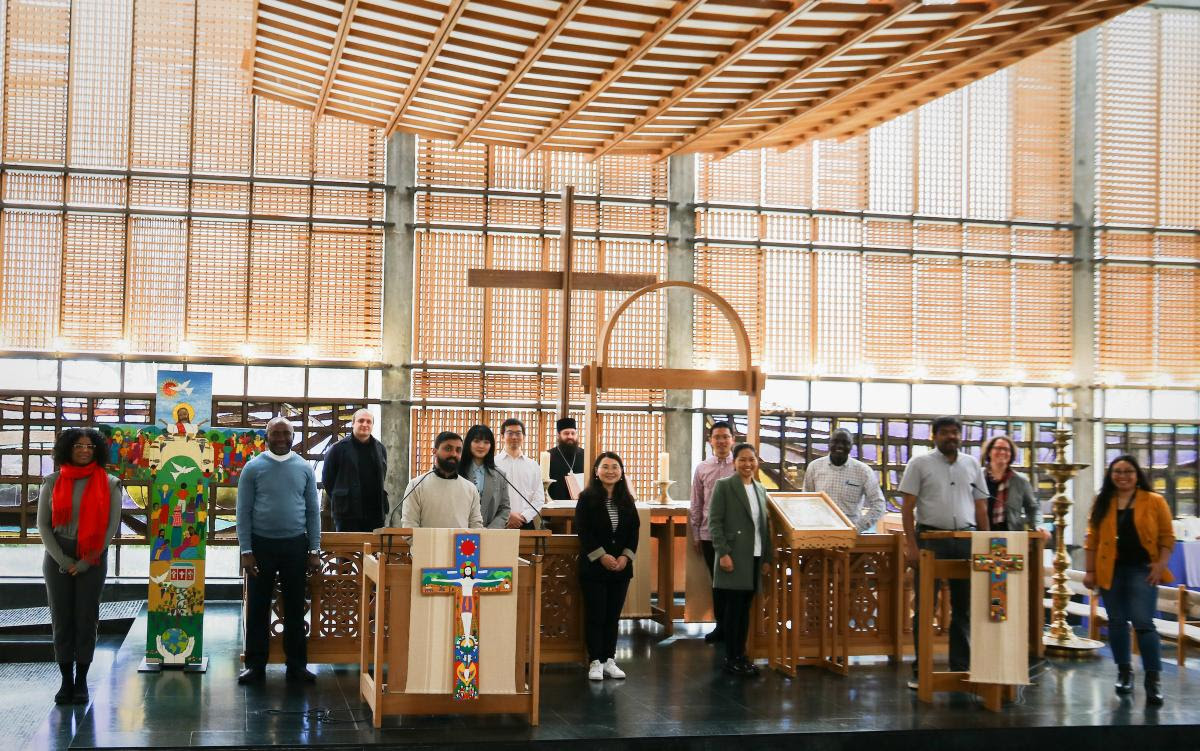
World Council of Churches (WCC) specialized ministries and roundtable partners are gathering on 3-4 May at the Bossey Ecumenical Institute for a “Working Together” meeting filled with a spirit of interconnected learning and preparation for the WCC 11th Assembly.
Participants of the "Working together" meeting held in Bossey, Switzerland on 3-4 May 2022.  Photo: Ivars Kupcis/WCC
04 May 2022

The gathering is also a place for mapping the future as the WCC anticipates a new programme and funding cycle beyond the assembly.

Participants are gathering with a spirit voiced by the apostle Paul: “Welcome one another, just as Christ has welcomed us.” This marks the first time the group is together in-person since 2019.

"We’ve been discussing questions such as: What have we been able to do together? What  learnings do we take forward, especially toward the WCC 11th Assembly and beyond?” said Patti Talbot, team leader for the United Church's Global Partnership Program. “Most of WCC’s programmes are the result not of a single year, but several—the outcome of dialogue, learning, review.”

As the WCC 11th Assembly quickly approaches, Working Together participants will finalize cooperation between WCC staff and specialized ministries to resource the assembly. They will also exchange learnings, envision directions and identify collaborative opportunities. Finally, they will be initiating reflection about the 2023-2030 cycle of shared witness and work.

“I give thanks for the tremendous commitment and compassion of those gathered,” said Rev. Nathan Day Wilson, WCC liaison to specialized ministries. “I wanted this year’s gathering to stress that we are partners, collaborators, essential members of the one ecumenical movement.”

WCC Working Together is an annual meeting to increase the shared knowledge between specialized ministries and the WCC in order to strengthen collaboration and mutual support, particularly in relation to WCC programmatic work, and to enhance WCC planning and reporting mechanisms.

Photos from the "Working Together" meeting in Bossey

See more
The World Council of Churches on Facebook
The World Council of Churches on Twitter
The World Council of Churches on Instagram
The World Council of Churches on YouTube
World Council of Churches on SoundCloud
The World Council of Churches' website
The World Council of Churches promotes Christian unity in faith, witness and service for a just and peaceful world. An ecumenical fellowship of churches founded in 1948, today the WCC brings together 349 Protestant, Orthodox, Anglican and other churches representing more than 550 million Christians in over 120 countries, and works cooperatively with the Roman Catholic Church. The WCC acting general secretary is Rev. Prof. Dr Ioan Sauca, from the Orthodox Church in Romania.

Media contact: +41 79 507 6363; www.oikoumene.org/press
Our visiting address is:
World Council of Churches
150 route de Ferney
Geneve 2 1211
Switzerland

Friday, February 18, 2022

WCC NEWS: As Bossey students help lead prayers, they find hope “as long as churches are willing to journey together”

Students from the Bossey Ecumenical Institute deepened their understanding of the ecumenical movement as they helped lead prayers during the World Council of Churches (WCC) central committee meeting, held via videoconference 9-15 February.
Bossey students and World Council of Churches staff gathered in the Ecumenical Centre chapel in connection with the WCC central committee meeting. Photo: Gloria Koymans/WCC
17 February 2022

As the students served as stewards, they enriched the spiritual life of the meeting, said Rev. Dr Mikie Roberts, WCC programme executive for Spiritual Life, who said the students were “a wonderful spiritual gift to our common ecumenical prayer.”

Roberts added: “Their presence in the chapel was a sign of the rich fellowship we share as the WCC and how our praying together is indeed at the heart of the global ecumenical movement.”

Bossey student Abel Lamido, from the United Methodist Church in Nigeria, said that leading the prayers helped remind the WCC central committee to promote Christian unity and justice for all. “The commitment and seriousness of the committee members give WCC hope,” said Lamido.

Another student, Rev. Rongliang Bian, from the China Christian Council, expressed appreciation for the opportunity to participate in the WCC central committee prayers.

“Even though we are all in a virtual meeting room, the moving of the Holy Spirit can transcend the limitations of time, space and even language, and we can still pray and worship together as one body in Christ closely connected,” said Bian. “The Bible is one of the foundations of our unity.”

Another student from the China Christian Council, Du Peng, said it was a great privilege to pray with Christians and church leaders from different countries. “I experienced this beautiful visible unity in prayer myself, as well as the special touch of wonderful, lively and diverse prayer, a beautiful feeling that is unforgettable,” said Peng. “Although we live in different places, we live on the same earth, and at the same time we share the same faith and the same good hope in Christ.”

Bossey student Rev. Jebin Thankaraj said the group experienced not only diverse prayers and songs but also the diversity and importance of musical instruments from all the continents during the ecumenical prayers.  

“There is hope for the ecumenical movement as long as churches are willing to journey together, recognizing and realizing one triune God working in each other,” said Thankaraj.

Sijo George, a student from the Malankara Mar Thoma Syrian Church, Republic of India, experienced the  the beauty of different liturgical traditions. “As a student, I became more curious to know how the ecumenical liturgy will bring people to be united in Christ,” said George. “It gives me a hope that the WCC and the churches recommend young scholars to be active in the ecumenical movement.”

Setting the stage for the prayer life in the meeting was an opening sermon by Rev. Dr Susan Durber, moderator of the WCC Faith and Order Commission. Durber underscored the importance of unity given the current challenges of COVID-19, the climate emergency, and many other serious challenges.

“Unity is not an option. It is vital for life,” said Durber. “When we are really up against it, we see what really matters.”

The closing sermon, offered by Rev. Gloria Ulloa Alvarado, WCC president for Latin America and the Caribbean, offered a reflection on what it means to listen to Jesus.
 

WCC central committee meeting 2022

Ecumenical Institute Bossey

See more
The World Council of Churches on Facebook
The World Council of Churches on Twitter
The World Council of Churches on Instagram
The World Council of Churches on YouTube
World Council of Churches on SoundCloud
The World Council of Churches' website
The World Council of Churches promotes Christian unity in faith, witness and service for a just and peaceful world. An ecumenical fellowship of churches founded in 1948, today the WCC brings together 349 Protestant, Orthodox, Anglican and other churches representing more than 550 million Christians in over 120 countries, and works cooperatively with the Roman Catholic Church. The WCC acting general secretary is Rev. Prof. Dr Ioan Sauca, from the Orthodox Church in Romania.

Media contact: +41 79 507 6363; www.oikoumene.org/press
Our visiting address is:
World Council of Churches
150 route de Ferney
Geneve 2 1211
Switzerland

Friday, January 28, 2022

WCC NEWS: Bossey sees new generation of students graduate, celebrating the experience of ‘a school of life’

Gathered at the Ecumenical Institute Bossey on 27 January, a group of more than 30 Bossey students joined faculty members, partners and friends of Bossey in celebrating the experience of “a school of life,” as they earned their post-graduate Certificates in Ecumenical Studies.
Gathered for prayer in the Ecumenical Institute chapel on 27 January. Photo: Peter Williams/WCC
28 January 2022

Despite the ongoing pandemic, the Ecumenical Institute has held sway and in September 2021 was able to welcome a student body of 33 students to begin their studies at Bossey.

Alongside the regular components of studies at Bossey, such as engagement with local church communities, visits to ecumenical partners and the Vatican, and not least the half-year-long experience of living in community with fellow students from all over the world, the study year of 2021/2022 also saw the Ecumenical Institute mark no less than 75 years of ecumenical formation.

Rev. Dr Simone Sinn, who serves as academic dean at Bossey since August 2021, affirmed the intense learning processes that took place during the past semester and encouraged students to share their ecumenical expertise in at least three different ways in their communities.

“Give inspiration to your church: articulate your hope and the theological vision that has grown in you during your ecumenical studies here. Moreover, share information and knowledge: be an ambassador who contributes to ecumenical literacy between churches. Thirdly, engage as facilitator: Organize ecumenical activities in your local context so that other people can themselves begin ecumenical journeys together,” Sinn said.

“Not just university studies, but a school of life”

For the students, studying at Bossey has indeed been a challenging yet also rewarding experience, as testified by many of them on the day of graduation.

Yevhenii Kravchenko, a student from the Ecumenical Patriarchate, speaks of Bossey as an experience that has opened up new ways to get to know other church traditions, coming himself from a mostly Orthodox context.

“In Ukraine where most Christians are Orthodox, we have dialogue with Catholics, Lutherans and Anglicans. But I have never before in my life had the experience of living together with them. When you live together and share space and share food, it is very different from just being in dialogue,” Kravchenko reflects.

“When I came to Bossey, I thought it would be university studies, but it is not just that. It is like a school of life, how we can live together as Christians,” he says.

Katharina Reis from the Evangelical Lutheran Church in Northern Germany continues: “Having studied in Bossey, I would say I feel changed in a way, and more open to people and different cultures and denominations, more curious about what is going on in the world.”

“Comparing to my own context, at least I have not before had so much contact with other Christian denominations, and so this is something I want to discover when I come back home, the richness that we have in Germany too,” she says.

Monique Jack of the Methodist Church in the Caribbean and the Americas says the experience at Bossey has meant an intense journey of oftentimes back-to-back activities that can seem a bit overwhelming, but which also in the end means new gifts for life.

“I can say now that I have friends in each of the continents,” Jack reflects. To study in Bossey, “come with an open mind and an open heart, be ready to learn and to not always have your own concepts at the forefront, but be ready for a challenge too. Be prepared to live in community life, to learn about the different traditions – not just church traditions, but cultural traditions,” she says.

In the end though, she reflects, “one of the things I really didn’t expect, was how quickly I felt like I could fit in, how all the students and faculty here are so willing to show you around and to be open. I believe I have been given tools here that will help in the ecumenical formation that has already taken place in my context, and maybe help branch off into new ones,” she adds.

Applications open anew for Bossey online course in ecumenism (deadline 15 February)

Photos from the graduation ceremony – January 2022

Study at the Ecumenical Institute Bossey

See more
The World Council of Churches on Twitter
The World Council of Churches on Facebook
The World Council of Churches' website
The World Council of Churches on Instagram
The World Council of Churches on YouTube
SoundCloud
The World Council of Churches promotes Christian unity in faith, witness and service for a just and peaceful world. An ecumenical fellowship of churches founded in 1948, today the WCC brings together 349 Protestant, Orthodox, Anglican and other churches representing more than 550 million Christians in over 120 countries, and works cooperatively with the Roman Catholic Church. The WCC acting general secretary is Rev. Prof. Dr Ioan Sauca, from the Orthodox Church in Romania.

Media contact: +41 79 507 6363; www.oikoumene.org/press
Our visiting address is:
World Council of Churches
150 route de Ferney
Geneve 2 1211
Switzerland