Showing posts with label Donna Frischknecht Jackson. Show all posts

Sunday, February 20, 2022

A church changed by COVID - The cost of connecting in new ways

By Sue Washburn | Presbyterians Today
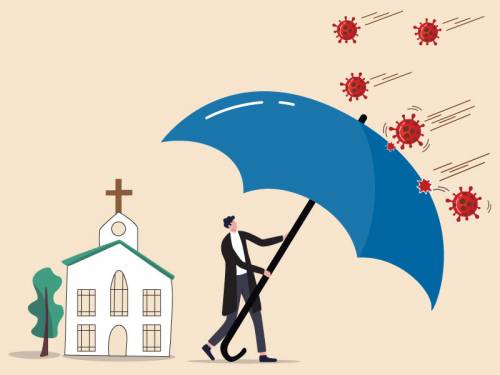
Illustration of a man holding a giant umbrella, shielding his church. Covid molecules are bombarding the umbrella.It’s been two years since COVID-19 entered our lives. During that time, our world has changed — and with it the church — as ideas of what church is have been reshaped by livestreaming worship and Zoom meetings and Bible studies. With COVID and its variants still factoring into everyday decisions and plans, congregations are just now beginning to understand the long-term impact the virus will have on not only a church’s mission, but also on its infrastructure. What kind of technology and staffing will be needed as churches move forward? Should pastors, many of whom figured out how to get online with a phone, be expected to continue with those responsibilities indefinitely? Or does the church staff need to change for a post-COVID world?

The Rev. Christy Ramsey, stated clerk and general presbyter of the Presbytery of Nevada, has been an advocate of media in ministry for decades. He says each church did what it could to keep people connected to God and to each other in the throes of the crisis, but now comes the more complicated question: What next? What are realistic expectations in terms of sustainability as the added responsibility of technology brings with it additional costs and job responsibilities?

“Some churches had lots of money and staff and could get online with all of the bells and whistles,” he said. Other congregations repurposed the equipment they already had. He vividly remembers the day he went to one small church. “The internet didn’t work because it hadn’t been used for a year and a half, but once that was running, they got an old TV and put it up on chairs so that the tiny congregation could sing to YouTube videos,” said Ramsey.

Another church in the presbytery mailed out the weekly sermon via the Postal Service and asked people to read it on Sunday at exactly 10 a.m. to create a unified time of worship. The big questions, though, Ramsey points out, aren’t necessarily about technology. They are about connection and what tools will be needed for that connection — and, at what cost.

Change is here to stay

While many churches were creative with outreach during the pandemic, the challenge now is to incorporate the changes into common practice. Do congregations have enough volunteer support to continue livestreaming? Is there financial support for equipment upgrades? Will churches change the staffing requirements as music directors need to research which hymns or anthems the livestreaming license covers? And then there’s the big question: Does the pastor need to be technologically savvy in addition to being theologically trained?

The Rev. Dr. Joseph Scrivner, pastor of Brown Memorial Presbyterian Church in Tuscaloosa, Alabama, first went online from his home when the pandemic started.

“I’ve jokingly said, ‘I’m the chair of the audio visual committee,’” said Scrivner. The one-person committee started when he picked up an iPad at home.

While Scrivner took responsibility for recording his sermons, the church officers stepped up their engagement with pastoral care. “Their resiliency has been a blessing, and the members modeled mutual pastoral care for one another,” he said.

The Rev. Jessica Crane-Munoz, pastor of Sunrise Presbyterian Church in Great Falls, Montana, took a new call during COVID, inheriting a volunteer who sets up the livestreaming weekly.

At her former church, she prayed weekly that a volunteer from the church would show up and learn how to push the buttons. The congregation now has a regular volunteer to get the church online every Sunday. However, she worried about the day when the volunteer was sick or not available since no one else knew the necessary steps for livestreaming.

All hands on deck

Both getting and staying online require an “all hands on deck” approach. Not all pastors have the skills of Scrivner and Crane-Munoz, and some congregations rely solely on volunteers to get them online. Many congregations are still not able to get online because of the steep learning curve and the lack of internet or reliable cell service.

As solo pastors, Scrivner and Crane-Munoz were both good with technology and able to lead the move to online. For both, there’s been give-and-take between the expectations of the pastors and volunteers. But in the suburbs of Philadelphia, Elkins Park Presbyterian Church decided to go a different path even before COVID.

Elkins Park Presbyterian Church hired a media contractor to help with its digital ministry, even though the pastor is tech-savvy. Courtesy of Elkins Park Presbyterian Church

As part of its strategy to become a vital congregation, the church decided it needed to be present in the digital community and committed to hiring a media contractor.

Before the pandemic, Elkins Park paid an offsite media contractor to manage its church website and social media accounts and to make slideshows and videos of church events to share online. Pre-COVID, the media contractor did not attend worship. However, since COVID, the job has changed to onsite, adhering to the necessary precautions to keep everyone safe.

“We feel it’s important to use technology to do that. I don’t see how a church can survive today without a strong media presence,” said Karen Sheehan, an elder at Elkins Park.

Neither does she think that technical responsibilities should fall to a pastor.

“Every church should look into hiring someone who has media skills to take the burden off the pastor,” Sheehan said, “even if the pastor has the skills.”

Danielle Mink, the technical and communications director at Unity Community Church in Pittsburgh, started as a part-time hire in 2002 when she was in eighth grade. Today she is full-time with benefits. “The challenge now is creating meaningful connection for the people who are only online,” Mink said.

“Churches that have hired someone to do media discover that they can always find more for that person to do,” said the Rev. Derek Campbell of Unity.

When it comes to tech job descriptions, there is no one-size-fits-all for churches. Media and tech jobs can range from five hours a week to full-time with benefits. Responsibilities for media personnel can include website maintenance, social media posting, video production and livestreaming as well as creating slides for worship, maintaining equipment and licenses, and scheduling volunteers. Compensation generally begins at $10 an hour for the smallest congregations. But whatever the details might be, one must be in all tech job descriptions: A church’s digital media message must complement its mission and should not feel like a corporate media post. Second Presbyterian Church in Nashville, Tennessee, is reworking its associate pastor job description to include media proficiency so that the media are infused with spirituality.

“We want to be sure the technology creates a worshipful experience,” said the Rev. Dr. Mary Louise McCullough. Fusing technology and faith to create a powerful online worship experience requires both technical and theological knowledge.

Online worship benefits

The benefit of online worship is it allows members to participate in what Ramsey calls “the church of their heart.” For some, the church of their heart is the congregation they attended during their youth, before they moved away or became homebound in old age. “Online worship has also been a great way to reach our shut-in members,” said Scrivner. But he says young people like online worship because it allows them to find a congregation that shares their values. “Our understanding of what it means to be a member is changing,” he said.

What isn’t changing is the realization that “there is no going back to just in-person worship,” said McCullough. While volunteers and staff scrambled to get the church online, the current task is to discern what is sustainable and remain flexible in planning for whatever God has next.

Sue Washburn is an interim pastor near Pittsburgh.


Hiring Thoughts for the Future

One of the impacts of COVID has been the “great resignation,” as those in professions from ministry to teaching reevaluate their calling in life. Vacated church positions present an opportunity for staffing structures to be reimagined. Salary line items could be reallocated to make room for a part-time tech guru.

Many churches are looking carefully at budgets and seeing where money can be found to accommodate the new skills and responsibilities needed for ministry today. So, whether it’s a new pastor, administrator or musician who needs to be hired, think creatively and identify the skills needed to move the mission of the church forward. Here are some things to think about when hiring.

Church administrators. Timely, responsive communication with parishioners requires more than paper and a copier. Video channels, texting and social media are common ways of connecting with people. Administrative assistants should be proficient in these communication tools, too.

Musicians. Livestreaming music means keeping licenses up to date, checking copyrights and accurately reporting what music gets played over the internet.

Pastors. While it’s debatable how much technology expertise should be in a pastor’s job description, the flexibility to provide leadership and pastoral care by phone, text or in person is imperative for a multigenerational church. The size and resources of a church will determine whether volunteers or staff maintain the online presence.

—Sue Washburn and Donna Frischknecht Jackson

Thursday, September 3, 2020

Churches discern creative approaches and start new traditions

The Reformation ‘rummage sale’

By Donna Frischknecht Jackson | Presbyterians Today
First Presbyterian Church of Hightstown, N.J., took its breathtaking indoor displays outdoors. Here, Pentecost “flames” pouring out of the building become a powerful symbol for the church today. Courtesy of First Presbyterian Church
Phyllis Tickle, the late author and founding editor of the religion department at Publishers Weekly, once wrote that every 500 years the church experiences a “massive upheaval,” where old ideas are rejected and new ones emerge. Tickle used the analogy of a “500-year rummage sale” to illustrate how the church enters into a period of cleaning house, deciding what to keep and what to toss in order to make way for the new thing God is doing. The author daringly proposed that with 2017 marking the 500th anniversary of the Protestant Reformation, the church was due for another “tectonic shift” in Christian tradition, resulting in “huge changes of both understanding and of practice.”
Three years later, Tickle’s prophecy seems to have come true. A great rummage sale has begun as Presbyterian congregations grapple to make sense of the changes the pandemic has brought not only to Sunday morning worship, but to what it means to be a Christian in this new world. And, as pastors step into their pulpits this October for Reformation Sunday, there will be no truer words spoken than that of the Reformation cry of “reformed and always reforming” — especially as those words will be carried into homes virtually with technology still being mastered by Presbyterians.
While it’s too early to tell what the long-term effects of the pandemic will be on churches, congregations are discerning what traditions to keep and what to toss, and what innovations are here to stay. For congregations who are dipping their toes back into the waters of in-person worship, there are noticeable changes. At Putnam United Presbyterian Church in Putnam, New York, the risk of spreading the coronavirus through congregational singing has led to a new worship experience that session plans to continue even when communal singing returns. That is incorporating an extended period of silence after the preacher’s sermon. Traditionally, after the preaching of the Word, the congregation would sing a hymn. But in the time of COVID-19, a holy space for stillness was presented to — and welcomed by — the congregation.
While much-needed quiet time in the church service has been an unexpected blessing in the pandemic, other Presbyterians are seeing the emergence of dual congregations — balancing both in-person and virtual worship communities. This has led to yet to be answered questions of how virtual and in-person congregations will affect the way membership is defined and how attendance is tallied, not to mention how virtual worship might add more pressure to a pastor’s schedule and/or bring to light the needed tech skills that might be missing in a congregation. Could “technology pastors” be a new job description in the making?
Still other Presbyterians wonder how many people will return to in-person worship when the dust of the virus settles.
“Who will come back and who will choose to worship virtually remains to be seen,” said Marie Bell, an elder at First United Presbyterian Church in rural Salem, New York. While the use of technology in worship was once resisted by many older congregations, churches like First United have found it a necessity to become part of the 21st century.
What Cambridge United Presbyterian Church in Cambridge, New York, has sold in its metaphorical rummage sale is the idea that a preacher needs to be physically in the pulpit on Sunday mornings. Jane Wright, an elder at Cambridge United Presbyterian, was tasked with keeping worship chugging along after the church’s pastor retired before the pandemic shut down church buildings. Wright didn’t know how much of a challenge coordinating worship would be in a time of pandemic. With the struggle of securing pastors to preach in person now that the church is practicing safe-distanced corporate worship, Wright has gotten creative and has been turning to prerecorded worship videos available from other churches (with permission from the respective pastors). The videos, projected on a screen in the fellowship hall, help in a bind on Sundays without a pastor.

Cultivating a deeper spirituality

The era of a new reformation has presented Kenilworth Union Church in Kenilworth, Illinois, with an opportunity to deepen its spirituality with a series of online quiet services. The congregation was first introduced to this idea a few years ago when the Rev. Dr. Jo Forrest, senior associate minister for congregational care, suggested a Blue Christmas service.
Blue Christmas — or as it is sometimes called, the “Longest Night service” — has become popular over the years among Presbyterians, offering a healing space for those who are grieving or feeling lonely amid the joviality of the holiday season. But rather than calling it “Blue Christmas,” Forrest advertised the service as a “Quiet Christmas,” broadening its reach to those who might not specifically be grieving, but still needing peace amid the December festivities. The Quiet Christmas, featuring liturgy written by church members, was well received, opening the conversation of doing more services throughout the year. Forrest could see such a service for Ash Wednesday, but when an elder asked during a Zoom meeting before Easter 2020 for such a service to be held in Eastertide, Forrest was surprised. She didn’t think of “quiet” and “Easter” together. The more she thought about it, though, the more it made sense — the body of Christ was overwhelmed with a world that had been turned upside down. The more it was discussed, the more there was a resounding “yes” to do it. “There was this acknowledgment that now more than ever we needed such a service,” said Forrest.
The first week of Easter, on a Tuesday, all who wanted to reflect by the empty tomb were invited to join Kenilworth Union Church to do so virtually with a service that, like the Quiet Christmas, featured liturgy written and read by church members. Forrest described the time of worship as “Spirit-led” and “homespun” — nothing fancy, just honest and from the heart.
Quiet services have now become an integral part of worship at the church, being held quarterly. The next service will be an interfaith Quiet Harvest held in October to coincide with Sukkot, a Jewish harvest festival that also commemorates the biblical story of the Jews’ escape from Egypt, where they wandered for 40 years through the desert, living in temporary shelters.

Newfound energy

When the pandemic hit, Christine Burns, a Commissioned Ruling Elder at Fredericktown First Presbyterian Church in Fredericktown, Ohio, wasn’t ready for all the challenges that were to come. “To say it was challenging is a phenomenal understatement. The feelings of inadequacy can more than border on overwhelming,” said Burns. But as the CRE was closing the doors to the sanctuary in early March with “no virtual presence” in place to keep the congregation connected, Burns didn’t lament. The pastor quickly signed up for a Zoom account and began holding worship from her kitchen table. She did so even though she knew many in her congregation didn’t have the equipment. Nor did the place they called home have reliable high-speed internet. Burns points out the infrastructure in rural Ohio is “pitifully ill-equipped.” Still, she kept the faith and persevered. As she did, something beautiful began happening. The grown children of her parishioners stepped up and helped their elderly parents gain access to virtual worship, either supplying them with the computers needed or coming over and streaming worship on their own tablets. Burns is in awe as to how she witnessed an “amazing metamorphosis” happening in her church.
Due to shorter in-person worship services and no congregational singing, Putnam United Presbyterian in Putnam, N.Y., has embraced more moments of quiet on Sunday mornings. Donna Frischknecht Jackson
“An epidemic faith emerged in the midst of the COVID-19 pandemic,” she said, adding that the “Spirit is moving us and shaking us even from behind our closed doors and our masks.”
“Worship in our congregation has become so important that people who have never used computers have seized the opportunity to join in communal worship through Zoom and Facebook and YouTube,” said Burns. “Those with poor or no internet have found hotspots so that we could all worship together.”
Perhaps, though, the most amazing metamorphosis that has happened at Fredericktown First Presbyterian is the emergence of a technology team. Yes, a rural church with a congregation that falls into the “vulnerable” category, due to age and health issues, has a four-person technology team. And it all began with one parishioner coming forward during the inaugural Zoom worship services from Burns’ kitchen table to offer suggestions as to what can be done in the future. For so long, the pastor was asking for people to step up and use their gifts. The pandemic created that opportunity, she said.

Looking out beyond

Technology isn’t the only focus of the new reformation Presbyterians are entering into. Churches are also finding creative ways to take the message out to the community that while the building might be closed, the church is still alive and well. One way to do that is to literally use its outdoor space as its billboard.
Since 2011, First Presbyterian Church of Hightstown, New Jersey, has been wowing worshipers with its art installations that have taken the traditional sanctuary from beautiful to breathtaking. Working with the themes of the liturgical season, the six-member Art Ministry team creates decorative displays that enhance the worship experience. The very first installation they did was for the Advent season and featured nylon fabric draped from the ceilings to create an ethereal feel. But it was Pentecost when the creativity was  unleashed, according to Anne Willis, a member of the art team. In the past, yards of orange, red and yellow fabric were draped around the sanctuary, with the remaining yardage pooled at the front of the pulpit, representing a burst of Pentecost flames.
It was a sight to behold in past years, but one that would not be seen by anyone in 2020. That’s when the art team decided to create a Pentecost display outdoors.
A wooden cross wrapped in chicken wire, allowing for prayers to be written on paper and attached to it, already set up outside for Lent, would remain the focal point, but would now have Pentecost “flames” draped around it. Wanting to achieve the feeling of movement, it was decided that the fabric should be draped from the very top of the church building and have it cascade out and down to the ground. It was not an easy task, as the window to pull the fabric through was only accessible via a ladder to a space above the sanctuary. Where there’s a will, there’s a way — and the art team managed to find a way. The material was pulled through the window and hurled down to the ground, where the surplus was then pooled around the wooden cross and stapled to boards and anchored to the ground.
When the team was done, they were in awe as to what had just been created. Before their eyes was the most perfect symbolism of Pentecost — God’s mighty and fiery Spirit pouring out of a building and onto the streets below.
“It was like the very first Pentecost with the Spirit descending upon those gathered and leading them out to share the good news,” said Willis. And share the good news First Presbyterian of Hightstown has done, with the “feedback from the community being overwhelming.”
In July, when the Pentecost installation was disassembled — as the “fabric was fading,” Willis said — a person was found kneeling in prayer at the cross.
The art ministry team will continue thinking about outdoor installations as they move into the fall months. In fact, the youngest member of the team, a 16-year-old, has suggested an outdoor prayer walk, using the 16 10-foot-tall banners depicting Jesus’ teachings that the church has had in storage. According to Willis, the banners were originally made to be hung outdoors, but that never happened. This fall, though, the banners will hang around the exterior of the church. In between each banner will be meditation questions, inviting people to reflect on how they can help their community.
Willis is excited with this opportunity to create eye-catching art displays outdoors. The team has talked “for years” about doing more installations beyond the sanctuary.
“It’s something we never got around to. The pandemic has made it all happen,” said Willis.
White Lick Presbyterian Church in Avon, Indiana, is also creating an outdoor worship space — an idea that began at the end of the summer when the congregation began sprucing up its property. According to White Lick member Cassie Brooks, as the grounds were cared for, the idea for prayer stations emerged. So, in addition to mowing and weeding, posts to hold prayer plaques were pounded into the ground and benches were provided. The congregation was then invited to submit their favorite Scripture passages to be featured as part of the White Lick Presbyterian prayer walk. Brooks says the passages will be laminated, posted and changed out periodically. “It’s one way to bring peace and comfort to anyone who visits our property,” she said.

Keep discerning

Martin Luther, the Reformer who created controversy by posting his 95 Theses to the church door in 1517 in Wittenberg, Germany, was noted to have said that in his busiest times he must spend hours in prayer at first.
Today’s churches are recognizing, too, that for change to occur, prayer and discernment must happen. At Sedgefield Presbyterian Church in Greensboro, North Carolina, this is taking place with a newly formed Plan Ahead Task Force.
“The landscape of the church is evolving, and it is vital for us to be forward thinking,” said the Rev. Kim Priddy. “As a ‘new normal’ is implemented and freedom of movement is introduced, we need a task force to consider the challenges that are ahead of us.”
The task force consists of six people, all with various gifts and backgrounds, including health-care professionals, who are asking questions such as: How do we continue to worship as some members may not be able to come back immediately as stay-at-home orders change? How do we continue to build community with our new online worshipers? How will Christian education and mission work be done? And, how can we partner with the community to meet the needs of those on the margins?
“This pandemic has allowed us to hold a mirror up to ourselves to see what kind of church we are — what is it that we do best and what is it we can let go of,” said Priddy.
Sedgefield Presbyterian is a “very missions-minded church,” and the congregation, Priddy says, has found creative ways to reach out to others: morning coffee via FaceTime, fellowship in driveways, grocery shopping for one another, gift baskets for those homebound, cards and, let’s not forget, the ever effective phone calls.
“We didn’t plan for this pandemic and we could not even conceive it, but good has come from it,” said Priddy. “I often imagine that this is what it was like when Jesus told Zacchaeus, ‘Hurry down, I must stay at your house today.’ We can get overwhelmed that we did not plan for this, but what a blessing it is to know that we are in the presence of God.”
Donna Frischknecht Jackson is the editor of Presbyterians Today.