Showing posts with label Benjamin Simon. Show all posts

Tuesday, March 3, 2026

WCC interview - Rev. Prof. Dr Benjamin Simon: "WCC needed now more than ever

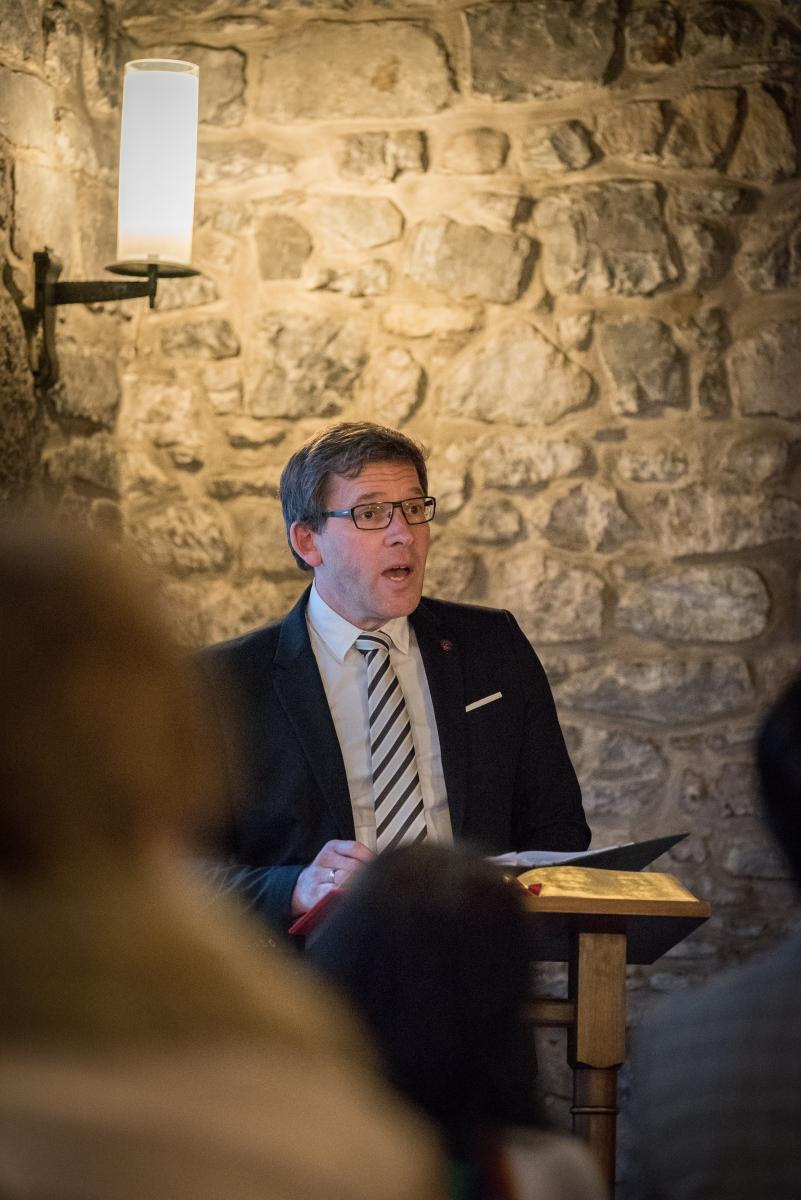
Rev. Prof. Dr Benjamin Simon, former dean of the Ecumenical Institute at Bossey, now serves as the director of DM (Dynamique dans l´ Echange), the Mission Board of the Reformed Swiss Churches in French-speaking Switzerland, as well as current chair of intercultural theology at University of Lausanne. He took time to reflect on his new roles, and why the World Council of Churches (WCC) is needed now more than ever, and how he will observe Lent.
Photo: Albin Hillert/WCC
3 March 2026

Please describe your new organization and your roles; your ecumenical family is eager to hear!

Simon:The Mission Board of the Reformed Swiss Churches has 36 partners in 14 different countries on four different continents. We focus on three different areas: sustainable ecology, education, and conviviality, which incudes living together, human rights, theological formation, and inter-religious relations.

We have a staff of nearly 20 people based in Lausanne, Switzerland, and around 30 people abroad. Next to the partnerships and developing a fellowship of churches, one of our aims is  to bring more cultural and ethnic diversity into the Swiss member churches—I think we have a lot to do!

In addition to this, I spend 30 percent of my time at the University of Lausanne at the Faculty of Theology, where I am in charge of intercultural theology. I am glad I can continue to work with one leg in church life and the other in academia—it’s a fantastic combination, from which both organizations benefit!

Even though it’s not easy to get the money we need for these endeavors, we have the possibility to mold our institutions in new directions. 

How do you look back on your many roles in the WCC?

Simon: I had worked for ten years with the WCC before I got the offer for my new roles, and took the opportunity. I must say, I take a lot away in my heart from the WCC. I was involved in so many different areas, not only teaching but also administratively, being dean and director of ecumenical formation. I spent time dealing with applicant churches, ecumenical officers, and even the COVID-19 support team—so many different aspects. What I’m taking with me is certainly the privilege of having had over 500 students from all over the world from different denominations sitting in one classroom. It was really about a mutual learning. I take with me the possibility of listening to them, which broadened my heart more for Christian diversity and religious diversity. Working with this multicultural staff and colleagues was amazing in an organization where everybody is coming from a different country and has a different language. That experience is really, really singular. I always saw this as a huge benefit and a huge gift, having such a context around you. 

I would like to share that, in these times of craziness, in these times of more and more problems all over the world, I think that there is a huge need for the WCC and its activities more than ever. I was always convinced as a staff of the necessity of WCC but now, from a distance, I see it even more.

How will you observe Lent this year? 

Simon: Lent is an invitation of God to reflect on our lives, and I think this is extremely important—even more important in these days with all these conflicts, to reflect on my life and not only for myself but for others. It is really about being compassionate and reflecting on the way we interact with each other. This is what I’m focusing on. 

See more
The World Council of Churches on Facebook
The World Council of Churches on Twitter
The World Council of Churches on Instagram
The World Council of Churches on YouTube
World Council of Churches on SoundCloud
The World Council of Churches' website
The World Council of Churches promotes Christian unity in faith, witness and service for a just and peaceful world. An ecumenical fellowship of churches founded in 1948, today the WCC brings together 356 Protestant, Orthodox, Anglican and other churches representing more than 580 million Christians in over 120 countries, and works cooperatively with the Roman Catholic Church. The WCC general secretary is Rev. Prof. Dr Jerry Pillay from the Uniting Presbyterian Church in Southern Africa.

Media contact: +41 79 507 6363; www.oikoumene.org/press
Our visiting address is:
World Council of Churches
Chemin du Pommier 42
Kyoto Building
Le Grand-Saconnex CH-1218
Switzerland

Thursday, February 11, 2021

WCC INTERVIEW: Rev. Dr Benjamin Simon brings “notion of conviviality” to WCC member churches

Rev. Dr Benjamin Simon became the World Council of Churches (WCC) programme executive for Church Relations in March 2020—just when the COVID-19 pandemic began to underscore the importance of bringing the WCC global fellowship together in new and creative ways.  
Rev. Dr Benjamin Simon.  Photo: Albin Hillert/WCC
11 February 2021

Simon is managing editor of the “International Review of Mission,” one of the WCC’s three academic journals, and recently earned a habilitation in Interreligious Studies and Intercultural Theologies from the University of Mainz. He also coordinates the WCC COVID-19 support team.

Below, Simon reflects on how he views his role as a bridge-builder for WCC member churches, the challenges 2020 brought, and his feelings about the 11th WCC Assembly being held in his hometown of Karlsruhe, Germany. 
 

You have been teaching at the WCC Bossey Ecumenical Institute since 2016. What most inspires you about your new role as WCC programme executive for Church Relations? 

Dr Simon: I see myself as an interface between member churches and also between WCC staff and colleagues—a bridge-builder and a networker. It’s actually all about strengthening the one ecumenical movement. This is the forward direction in which we have to move, one of ecumenical cooperation. I see this as a kind of ecumenic notion of conviviality. It is about learning from each other, sharing amongst each other, celebrating with each other. Those three pillars are very helpful to bring the worldwide fellowship forward towards unity. 

We are able to learn from and to share amongst the member churches the experiences they are having. And we are able to come together to find ways to celebrate and connect as people. This notion of ecumenic conviviality not only helps me define my role but also shows how we can grow together towards unity as a WCC fellowship.

This means we are able to share resources—such as the COVID-19 support team. We have received questions ranging from how to lead a liturgy to how to provide good pastoral care. We found that we can learn from each other far more than we previously realized.
 

Please, share with us some details about the new academic degree you recently earned from the University of Mainz. What inspired you to pursue it? 

Dr Simon: Well, on the one hand I am very much into academic theological reflections and on the other hand the topic of my thesis deals with a religious group I am familiar since my childhood: The Kimbanguist. By analyzing their history, theology and ecumenical orientation, I developed six steps that a religious group takes when it breaks away from a larger one to form its own religion. For sure highly interesting for all those who deal with the increasing phenomenon of “misleading theologies.”

By handing in this book at the University of Mainz, I was “habilitated.” The habilitation is the highest academic degree you can earn in German-speaking contexts, in Scandinavia and in France. It might be compared with a “second book.” But on top one has to pass an examination and such a book needs to be an outstanding contribution to the academic world. 
Being “habilitated” gives you the permission to teach courses at universities, to supervise doctoral theses and to be included in doctoral exams. You are, so to say, specialized in a certain academic field. I was honored with the teaching permission (venia legendi) for Interreligious Studies and Intercultural Theologies.  
 

You moved to Karlsruhe, Germany as a teenager. The 11th WCC Assembly will be held there in 2022! Does this have special meaning for you?

Dr Simon: Karlsruhe is absolutely my hometown. It is where my wife comes from, and where our five children were born. It’s a great feeling to have the WCC Assembly coming to Karlsruhe. It’s really an international place and a place of historical importance. In 1948, as an ecumenical fellowship we decided to stay together. In Busan, during the 10th WCC Assembly, we said we want to move together. I actually hope an outcome of the WCC 11th Assembly in Karlsruhe is that we say that we are ready to transform and to be transformed. The world needs a transformation like we have never had before. Transformation is really, for me, a central term, and Karlsruhe can be a place where we can get that input, that push forward we really need to make a change.
 

WCC COVID-19 Resources

See more
The World Council of Churches on Twitter
The World Council of Churches on Facebook
The World Council of Churches' website
The World Council of Churches on Instagram
The World Council of Churches on YouTube
SoundCloud
The World Council of Churches promotes Christian unity in faith, witness and service for a just and peaceful world. An ecumenical fellowship of churches founded in 1948, today the WCC brings together 350 Protestant, Orthodox, Anglican and other churches representing more than 550 million Christians in over 120 countries, and works cooperatively with the Roman Catholic Church. The WCC interim general secretary is Rev. Prof. Dr Ioan Sauca, from the Orthodox Church in Romania.

Media contact: +41 79 507 6363; www.oikoumene.org/press
Our visiting address is:
World Council of Churches
150 route de Ferney
Geneve 2 1211
Switzerland