Showing posts with label Russia. Show all posts

Tuesday, October 25, 2022

WCC NEWS: Exclusive interview with WCC acting general secretary after the visit to Moscow

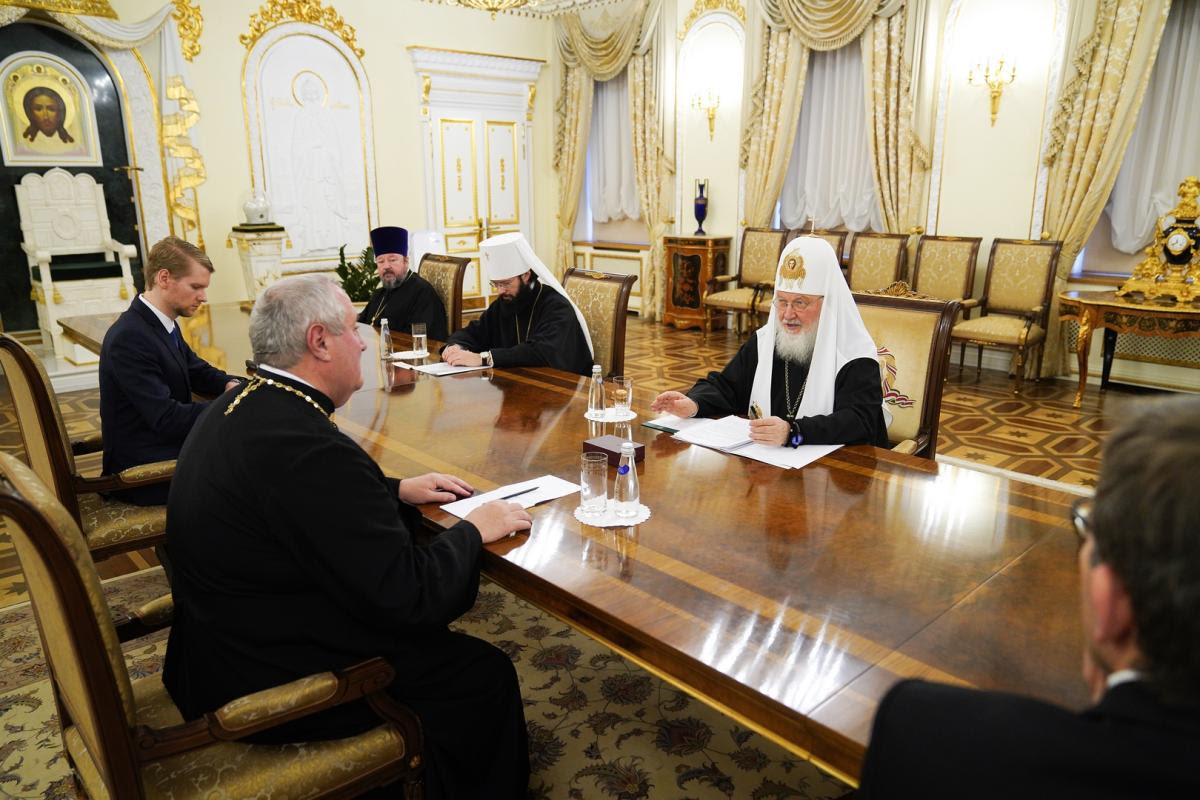
Patriarch Kirill of Moscow and All Russia and a WCC delegation led by the acting general secretary Fr Ioan Sauca met on 17 October in Moscow, discussing the current situation with the war in Russia and Ukraine and in light of the danger of nuclear war.
His Holiness Patriarch Kirill and World Council of Churches (WCC) acting general secretary Fr Ioan Sauca met on 17 October 2022 in Moscow. Photo: Moscow Patriarchate
25 October 2022

Q: Why did you visit Moscow?

The visit took place on request from the WCC central committee and is part of a series of visits that has already included the Middle East, Lebanon, Syria, Palestine, Israel, Ukraine, and now Russia, meant to build bridges of peace and reconciliation through encounters and dialogues and to avoid military conflicts, wars and violence.

The programme also included a visit to the Moscow Church Centre for Assistance to Refugees, and discussions with representatives from the Moscow Theological Academy.

We went there on the request of the central committee to try to start a dialogue on the theology of war. Other voices asked for an emergency visit in light of the danger of nuclear conflagration. (See text in the document  His Holiness Patriarch Kirill, WCC acting general secretary meet in Moscow, agreeing that war cannot be holy | World Council of Churches (oikoumene.org)

Q: What was the first reaction of Patriarch Kirill?

We met for several hours, and we had time for in-depth discussion. I had also a private audience with the Patriarch. I reported on the outcome of the WCC 11th Assembly in August-September, the statement on the war in Ukraine and the latest WCC central committee in June. Noting was avoided or hidden; we were clear with what we said in our statements and we were bold in our presentation. In the Russian delegation were present members of the WCC central committee who participated at the elaboration of the statement in June and those present at the WCC 11th Assembly who were members of the drafting committee which elaborated the statement on the war in Ukraine. Everything discussed in the meeting is not included in the report due to circumstances with local laws and the urgent need to continue the dialogue. We understand how to be sensitive to the situation in which the churches live and, while saying the full truth, we make sure we do not do more harm.

Patriarch Kirill said that the war is not done by the churches but by the politicians. And the churches' role is to be peacemakers, as we have noted in the report.

I went further with two questions which are not in our statements but voiced by some of our member churches: 1) What is his theological position on the war in Ukraine since there is a perception that he supports it as a "holy war?” 2) What is his explanation of using the term “metaphysical war” in relation to the war in Ukraine?

We have received his response, as mentioned in the report.

In conclusion: we did our job; we visited and spoke with Patriarch Kirill; we initiated a dialogue and saw the wish from the Russian side to continue the dialogue. In my opinion, we accomplished the mandate given by the central committee.

Q: Why were there only men in the WCC delegation?

 We went there with a small delegation, as this was not a normal church visit and there is war. We have different ways of handling the ecumenical and diplomatic protocol and this time it was a meeting between Patriarch Kirill and the acting general secretary, as you can read in the press release of  17 October.  WCC acting general secretary visits Moscow | World Council of Churches (oikoumene.org)

I was joined by Rev. Dr Benjamin Simon, WCC programme executive for Church Relations and accompanied by Fr Mikhail Gundiaev, the Russian Orthodox Church’s representative to the WCC. They were present due to their functions, not gender.  I have always tried to  have a balanced leadership in delegations but due to the special circumstances with the war the functions were this time the main focus, and I tried to keep the group small to establish dialogue as requested from the central committee. I knew that some reactions would come. In the WCC’s highest staff leadership group, we are three women and three men.

Our deputy general secretary Prof. Dr Isabel Apawo Phiri led the joint delegation with ACT Alliance to Russia in the end of May. WCC-ACT delegation visits Russia, sees church response to refugees from Ukraine | World Council of Churches (oikoumene.org)

The Russian Orthodox Church decided upon the gender and people attending from its delegation.

Also attending the meeting, which took place at the Patriarchal Residence in St Daniel’s Monastery, were Metropolitan Anthony of Volokolamsk, chairman of the Moscow Patriarchate’s Department for External Church Relations; Archimandrite Philaret (Bulekov), DECR vice-chairman; Fr Mikhail Gundyaev, representative of the Moscow Patriarchate to the WCC and international organisations in Geneva; Hieromonk Stefan (Igumnov), DECR secretary for inter-Christian relations.

Q: What will happen after the visit?

We will continue to monitor and pray about the situation and continue the dialogue. We are operating through four foci: church relations, peacebuilding, statements, and communication.

The staff person responsible for Church Relations will continue the follow up on church dialogue and will prepare the visits in relation to the request on the Church in Ukraine to become a member of WCC. Rev. Dr Benjamin Simon, as a professor in Bossey, was also entrusted to make sure that recruitment of Russian students to study in Bossey will continue.

Q: What do you say to those who say you did not speak up strongly enough against the war? Some people say that other global religious leaders have publicly used language more critical of the war than you have.

Since the Russian invasion of Ukraine began, the WCC  began making statements in February 2022, then by the WCC central committee in June, and by the WCC 11th Assembly in September. We made clear the position of the WCC regarding the humanitarian tragedy unfolding because of this war, naming it clearly an invasion, and aggression. It was nothing new or hidden: personally, I wrote about it to Patriarch Kirill and to Russian president Putin. Our correspondence has been documented at the following links:

Read full letter to Patriarch Kirill of Moscow (2 March 2022)

WCC urges President Putin to stop war, restore peace to Ukraine (WCC press release of 25 February 2022)

The WCC position is clear and that was not avoided but clearly stated when we met the Patriarch Kirill. In addition, the Russian members of the WCC central committee and those who were present at the WCC 11th Assembly were also present during the meeting with the patriarch. There was no reason to hide or dilute words or concepts when those were used in our statements and in our earlier correspondence with the patriarch. I can understand the use of the hermeneutic of suspicion by some critical voices, but here is not the case. We went there to have an open and truthful dialogue, and that is in fact what occurred.

I hope and pray that the fellowship of churches continues to and work towards just peace and towards the end of the war in Ukraine and the end of wars elsewhere in the world. I also pray that the WCC continues to be that open table which gathers Christians together and gives courage and patience to listen to one another even if we disagree. May we remain eager and committed to look together to building bridges of justice, peace, reconciliation and unity.  

*Marianne Ejdersten, WCC director of communication, based in Geneva, Switzerland

His Holiness Patriarch Kirill, WCC acting general secretary meet in Moscow, agreeing that war cannot be holy, 19 October 2022

WCC Communique: His Holiness Patriarch Kirill meets with WCC acting general secretary

Photo gallery: WCC acting general secretary visits Moscow

Statement of the WCC 11th Assembly: War in Ukraine, Peace and Justice in the European Region

WCC Central Committee Statement on the War in Ukraine (18 June 2022)

See more
The World Council of Churches on Facebook
The World Council of Churches on Twitter
The World Council of Churches on Instagram
The World Council of Churches on YouTube
World Council of Churches on SoundCloud
The World Council of Churches' website
The World Council of Churches promotes Christian unity in faith, witness and service for a just and peaceful world. An ecumenical fellowship of churches founded in 1948, today the WCC brings together 352 Protestant, Orthodox, Anglican and other churches representing more than 580 million Christians in over 120 countries, and works cooperatively with the Roman Catholic Church. The WCC acting general secretary is Rev. Prof. Dr Ioan Sauca, from the Orthodox Church in Romania. 

Media contact: +41 79 507 6363; www.oikoumene.org/press
Our visiting address is:
World Council of Churches
150 route de Ferney
Geneve 2 1211
Switzerland

Wednesday, October 19, 2022

WCC NEWS: His Holiness Patriarch Kirill, WCC acting general secretary meet in Moscow, agreeing that war cannot be holy

His Holiness Patriarch Kirill and World Council of Churches (WCC) acting general secretary Fr Ioan Sauca met on 17 October in Moscow, discussing how churches are called to be peacemakers.
WCC acting general secretary Fr Ioan Sauca meets patriarch Kirill, head of the Russian Orthodox Church at the Patriarchal Residence in St Daniel’s Monastery, Moscow, 17 October 2022. Photo: Moscow Patriarchate
19 October 2022

Also attending the meeting, which took place at the Patriarchal Residence in St Daniel’s Monastery, were Metropolitan Anthony of Volokolamsk, chairman of the Moscow Patriarchate’s Department for External Church Relations; Archimandrite Philaret (Bulekov), DECR vice-chairman; Fr Mikhail Gundyaev, representative of the Moscow Patriarchate to the WCC and international organisations in Geneva; Hieromonk Stefan (Igumnov), DECR secretary for inter-Christian relations; and Rev. Prof. Dr Benjamin Simon, WCC programme executive for Church Relations.

In addition to a public conversation, Patriarch Kirill and Fr Sauca had their own private audience to discuss Orthodox matters. 

Patriarch Kirill welcomed the guests, saying: “I appreciate that you have come to Russia in these hard times to meet with me and my people and talk about the difficult international relations we live in and are confronted with today which naturally affects our inter-church relations, as well.”

Fr. Sauca thanked the Primate of the Russian Orthodox Church for the meeting, and said: “The members of our fellowship are looking with great interest and hope to this visit,” explaining that the WCC delegation came to Moscow because of a mandate from the WCC central committee to visit WCC member churches with “bleeding wounds.” Those visits have included the Middle East—Syria, Lebanon, Israel, and Palestine—and then Ukraine, and now Russia.

“You are aware of the concerns” that WCC member churches have with regard to the war between Russia and Ukraine, said Fr Sauca, “and of our statements that condemn the war and violence which we made in our governing bodies – the statements which were elaborated with the participation of delegates from the Russian Orthodox Church.”

World Council of Churches acting general secretary Rev. Prof. Dr Ioan Sauca and patriarch Kirill. Photo: Moscow Patriarchate

Fr Sauca expressed his gratitude for previous correspondence with Patriarch Kirill.

“The reason for coming here is to see what we can do together to build bridges of peace and reconciliation and stop the bloodshed and the danger of nuclear conflagration,” Fr Sauca said. “I think it would very helpful now to make the same statement, saying clearly to the world what you told us, here, today: stop the bloodshed, stop the killing, stop the destruction of infrastructure, look for peace and reconciliation.”

This will help greatly the world and the Orthodox Church as well, Fr Sauca said to Patriarch Kirill, “and will make it clear what is your personal position to the war.”

The patriarch stated that he does not think that any church or Christian can have a supporting position to wars and killings, and that churches “…are called to be peacemakers and to defend and protect life,” he said. “War cannot be holy.”

But when one has to defend himself and his life or to give his life for the lives of the others, things look different, stated Patriarch Kirill. “We have so many examples in our Christian history,” he said. “Yet, as peacemakers we have to make all efforts to bring peace through dialogue and avoid any conflict or violence.”

Patriarch Kirill added that the times in which we live today are very difficult—yet these difficulties do not come from the churches, “but from the political context, and this context constitutes an extreme danger today,” he said.

Churches today “must not add fuel to the fire,” he added. “On the contrary, we must do everything within our power to put out the fire. In this regard, the World Council of Churches has a very important function.”

WCC Communique: His Holiness Patriarch Kirill meets with WCC acting general secretary

Photo gallery: WCC acting general secretary visits Moscow

Statement of the WCC 11th Assembly: War in Ukraine, Peace and Justice in the European Region

Participants of the meeting, from left: Fr Mikhail Gundyaev, representative of the Moscow Patriarchate to the WCC and international organisations in Geneva; Rev. Prof. Dr Benjamin Simon, WCC programme executive for Church Relations; Rev. Prof. Dr Ioan Sauca, WCC acting general secretary, Patriarch Kirill, Metropolitan Anthony of Volokolamsk, chairman of the Moscow Patriarchate’s Department for External Church Relations; Archimandrite Philaret (Bulekov), DECR vice-chairman and Hieromonk Stefan (Igumnov), DECR secretary for inter-Christian relations. Photo: Moscow Patriarchate
See more
The World Council of Churches on Facebook
The World Council of Churches on Twitter
The World Council of Churches on Instagram
The World Council of Churches on YouTube
World Council of Churches on SoundCloud
The World Council of Churches' website
The World Council of Churches promotes Christian unity in faith, witness and service for a just and peaceful world. An ecumenical fellowship of churches founded in 1948, today the WCC brings together 352 Protestant, Orthodox, Anglican and other churches representing more than 580 million Christians in over 120 countries, and works cooperatively with the Roman Catholic Church. The WCC acting general secretary is Rev. Prof. Dr Ioan Sauca, from the Orthodox Church in Romania. 

Media contact: +41 79 507 6363; www.oikoumene.org/press
Our visiting address is:
World Council of Churches
150 route de Ferney
Geneve 2 1211
Switzerland

Monday, October 17, 2022

WCC NEWS: WCC acting general secretary visits Moscow

World Council of Churches (WCC) acting general secretary Rev. Prof. Dr Ioan Sauca visited Moscow this week, meeting with H.H. Patriarch Kirill of Moscow and all Russia, and representatives from the largest WCC member church.

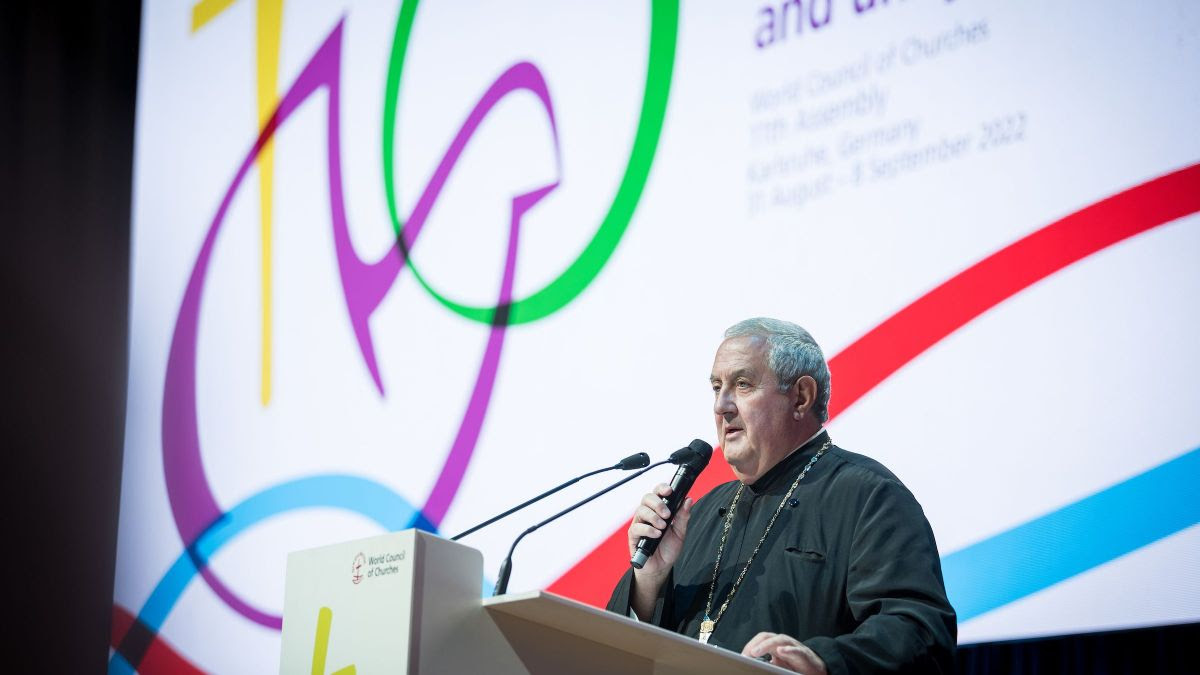
WCC acting general secretary Rev. Prof. Dr Ioan Sauca speaks in the introduction to a thematic plenary focused on Europe, at the 11th Assembly of the World Council of Churches, held in Karlsruhe, Germany from 31 August to 8 September, under the theme "Christ's Love Moves the World to Reconciliation and Unity", Photo: Albin Hillert/WCC
17 October 2022

Sauca focused on follow-up to the WCC 11th Assembly and in particular on the assembly public statement on the Russia Ukraine war.

The visit took place on request from the WCC central committee, and is part of a series of visits that has already included the Middle East, Lebanon, Syria, Palestine, Israel, Ukraine, and now Russia meant to build bridges of peace and reconciliation through encounters and dialogues and to avoid military conflicts, wars and violence.

The programme also included a visit to the Moscow Church Center for Assistance to Refugees, and discussions with representatives from the Moscow Theological Academy.

Sauca was joined by Rev. Dr. Benjamin Simon, WCC programme executive for Church Relations and accompanied by Fr Mikhail Gundiaev, the Russian Orthodox Church’s representative to the WCC.


Statement from the WCC 11th Assembly War in Ukraine, Peace and Justice in the European Region” 

WCC assembly statement calls for global ceasefire, renewed commitment to peace

WCC Central Committee Statement on the War in Ukraine


See more
The World Council of Churches on Facebook
The World Council of Churches on Twitter
The World Council of Churches on Instagram
The World Council of Churches on YouTube
World Council of Churches on SoundCloud
The World Council of Churches' website
The World Council of Churches promotes Christian unity in faith, witness and service for a just and peaceful world. An ecumenical fellowship of churches founded in 1948, today the WCC brings together 352 Protestant, Orthodox, Anglican and other churches representing more than 580 million Christians in over 120 countries, and works cooperatively with the Roman Catholic Church. The WCC acting general secretary is Rev. Prof. Dr Ioan Sauca, from the Orthodox Church in Romania. 

Media contact: +41 79 507 6363; www.oikoumene.org/press
Our visiting address is:
World Council of Churches
150 route de Ferney
Geneve 2 1211
Switzerland