Showing posts with label Orthodox. Show all posts

Monday, May 16, 2022

WCC NEWS: Church of Cyprus welcomes Orthodox from across the world to pray together

Local host and head of the Church of Cyprus, Archbishop Chrysostomos II, welcomed members of the World Council of Churches (WCC) Inter-Orthodox Pre-Assembly at his residence in Nicosia, Cyprus, on 12 May, the Feast of Saint Epiphanius. The meeting acknowledged contributions from the Church of Cyprus to the ecumenical movement, as well as the aspiration of churches to see a united island, partitioned as result of the Turkish invasion in 1974.
Archbishop Chrysostomos II of Cyprus welcomes participants at his residence in Nicosia, Cyprus on 12 May. Photo: Albin Hillert/WCC
13 May 2022

Archbishop Chrysostomos II warmly welcomed the members to his residence and underlined the needs for the Orthodox family to meet, discuss, pray, to prepare for the WCC 11th Assembly and try to overcome all obstacles they are facing at a time when the world is divided, and so are churches. He recalled the WCC’s important role to bring the Orthodox family together. He also acknowledged the important work by the WCC under the leadership of acting general secretary Rev. Prof. Dr Ioan Sauca.

At the meeting, Sauca expressed appreciation for the contributions from the Church of Cyprus to the ecumenical movement. Sauca commended efforts to work towards unity and the very concrete unification of Cyprus. “Since our vision at the WCC is to promote a platform of dialogue, your country becomes a beacon of hope in a divided world, as you are seeking peace, reconciliation and love between the communities,” Sauca said.

“We have for the last days experienced your great hospitality and  your strong commitment to the dialogue of life. This is one way of reminding people to build their dreams of a united, peaceful, prosperous Cyprus, even if this dream is accompanied by the memories of pain,” he said.

“It is our hope and prayer that the vision of the churches and religious communities in Cyprus for peace and unity is realized,” Sauca added.

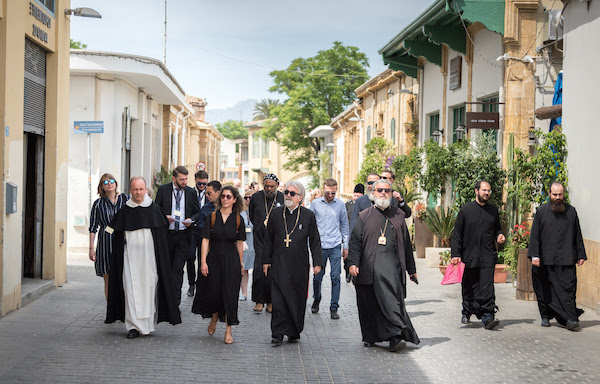
Participants in the Inter-Orthodox Pre-Assembly Consultation to the World Council of Churches’ 11th Assembly visit the old city of Nicosia on 12 May. Photo: Albin Hillert/WCC

Honoring a legacy

The archbishop hosted a lunch in Nicosia for the delegation and organised in the afternoon a visit to the old town of Nicosia, divided by the occupation. The group visited the buffer zone observed by the United Nations.

The diverse Orthodox family also celebrated the Feast of Saint Epiphanius, gathering at the Metropolitan Cathedral of Saint George in Paralimni, Cyprus.

Representatives of the 20 Easter and Oriental Orthodox WCC member churches gathered for the Feast of Saint Epiphanius. Photo: Albin Hillert/WCC
Chants, hymns and words of prayer filled the church as the representatives of a total of 20 different Eastern and Oriental Orthodox churches from around the globe venerated the saint together.
Observing a moment of prayer during the Feast of Saint Epiphanius. Photo: Albin Hillert/WCC
His Eminence Metropolitan Dr Vasilios of Constantia and Ammochostos of the Church of Cyprus welcomed the ecumenical group to the church, speaking of the importance of the annual day for the local church and of the legacy of Saint Epiphanius for the Church of Cyprus.
His Eminence Metropolitan Dr Vasilios of Constantia and Ammochostos of the Church of Cyprus leads the service. Photo: Albin Hillert/WCC
Saint Epiphanius is one of two patron saints of the Church of Cyprus today, the Metropolitan explained, noting that the 4th-century bishop and metropolitan of Church of Cyprus was instrumental in shaping the early days of this WCC member church – whose autocephaly was recognized at the third ecumenical council, convened in Ephesus in AD 431.
Dr Irini George of the Coptic Orthodox Church - one of the participants in the Inter-Orthodox Pre-Assembly Consultation venerates Saint Epiphanius. Photo: Albin Hillert/WCC

Hospitality at heart, in bringing Orthodox family together (WCC press release of 12 May 2022)

Orthodox churches pray and reflect on reconciliation as WCC 11th Assembly approaches (WCC press release of 10 May 2022)

Photo gallery: Inter-Orthodox pre-assembly consultation - 2022

Learn more: WCC 11th Assembly

See more
The World Council of Churches on Facebook
The World Council of Churches on Twitter
The World Council of Churches on Instagram
The World Council of Churches on YouTube
World Council of Churches on SoundCloud
The World Council of Churches' website
The World Council of Churches promotes Christian unity in faith, witness and service for a just and peaceful world. An ecumenical fellowship of churches founded in 1948, today the WCC brings together 349 Protestant, Orthodox, Anglican and other churches representing more than 550 million Christians in over 120 countries, and works cooperatively with the Roman Catholic Church. The WCC acting general secretary is Rev. Prof. Dr Ioan Sauca, from the Orthodox Church in Romania.

Media contact: +41 79 507 6363; www.oikoumene.org/press
Our visiting address is:
World Council of Churches
150 route de Ferney
Geneve 2 1211
Switzerland

Wednesday, May 11, 2022

WCC NEWS: Orthodox churches pray and reflect on reconciliation as WCC 11th Assembly approaches

Orthodox churches convened in Cyprus this week to prepare for the World Council of Churches (WCC) 11th Assembly, as well as to pray and reflect together on how to keep dialogue open amid the world’s grave challenges.
Participants at an Inter-Orthodox Pre-Assembly Consultation to the World Council of Churches’ 11th Assembly gather for prayer in the Monastery of Agia Napa on 10 May 2022.
10 May 2022

Fifty-two delegates representing 20 Eastern and Oriental Orthodox WCC member churches are participating in the gathering. “We are  praying, studying, discussing, and reflecting on the main theme of the assembly, ‘Christ's love moves the world to reconciliation and unity,’ from an Orthodox perspective,” explained Rev. Prof. Dr Ioan Sauca, WCC acting general secretary. “Discussions are also centering around current global challenges and how the Orthodox agenda at the WCC 11th Assembly can keep dialogue open.”

In introductory remarks, Sauca reflected on the uniqueness of bringing the Eastern and Oriental Orthodox churches together in these difficult and challenging times, and on the crucial role of the WCC in convening them.

He also expressed appreciation for the active role that H.E Metropolitan Prof. Dr Gennadios of Sassima, vice-moderator of the WCC central committee and moderator of the Assembly Planning Committee, has had over the years in planning the inter-Orthodox pre-assembly meetings, including the current one.

“It is so important that we come together to form a common Orthodox vision for the WCC assembly,” said Sauca. “I extend my hope toward that.”

Cypriot presidential commissioner Photis Photiou shared an opening welcome, commending the Orthodox churches for coming together, and thanking the World Council of Churches for providing “an open platform” for dialogue and for listening to one another.

The local host of the meeting, H.E. Metropolitan Vasilios of Constantia and Ammochostos (Orthodox Church of Cyprus), also shared words of welcome and reflected on the ongoing quest for reconciliation. He thanked those attending for their willingness to work toward a vision for the assembly. 

Rev. Dr Odair Pedroso Mateus, interim deputy general secretary and director of the WCC Commission on Faith and Order, gave an overview of the new publication “Pilgrims on the Path of Peace: The Journey of the WCC from Busan to Karlsruhe.”

“Spirituality, formation and prayer…belong to each other, and their mutual belonging is visible in important ecumenical spaces such as the Bossey Ecumenical Institute where we bring, every year, cultural diversity and confessional diversity into common life, common prayer and common study,” said Pedroso Mateus.

WCC director of the Office of the General Secretariat Doug Chial and Charlot Berlot, assembly administrator, offered a presentation on preparations for the WCC 11th Assembly, including expected outcomes and the significance of the first assembly in Europe since 1968. 

Chial also touched on the impact of the COVID-19 pandemic and the war in Ukraine. Finally, Chial shared that an unprecedented 90% of WCC member churches and 99% of Orthodox churches are sending delegates to the assembly. 

The assembly introduction also included a word from the local assembly office in Karlsruhe, Germany, under the leadership of Rev. Dr Marc Witzenbacher, who provided an overview of the local preparations to host the assembly. 

In the afternoon, the pre-assembly focused on the meaning of the theme "Christ’s love moves the world to reconciliation and unity.”

“The theme of the next WCC assembly in 2022 is a faith affirmation centering on Christ's love: Christ's love moves the world to reconciliation and unity,” said Sauca, and concluded: ”Against all powers of destruction and sin, it sees the person of the crucified and risen Christ at the heart of this world.”

10 May 2022, Agia Napa, Cyprus: H.E. Metropolitan Dr Vasilios of Constantia and Ammochostos of the Church of Cyprus (left) and Prof. Dr. Dimitra Koukoura (right) walk into the Monastery of Agia Napa for morning prayer. An Inter-Orthodox Pre-Assembly Consultation to the World Council of Churches’ 11th Assembly brings together more than 50 delegates representing 20 Eastern and Oriental Orthodox member churches, in Cyprus on 9-16 May 2022. Photo: Albin Hillert/WCC

Photo gallery: Inter-Orthodox pre-assembly consultation - 2022

Learn more: WCC 11th Assembly

Assembly theme resource: A reflection on the theme of the 11th Assembly of the WCC, Karlsruhe 2022

Report: “Pilgrims on the Path of Peace – The Journey of the WCC from Busan to Karlsruhe”


See more
The World Council of Churches on Facebook
The World Council of Churches on Twitter
The World Council of Churches on Instagram
The World Council of Churches on YouTube
World Council of Churches on SoundCloud
The World Council of Churches' website
The World Council of Churches promotes Christian unity in faith, witness and service for a just and peaceful world. An ecumenical fellowship of churches founded in 1948, today the WCC brings together 349 Protestant, Orthodox, Anglican and other churches representing more than 550 million Christians in over 120 countries, and works cooperatively with the Roman Catholic Church. The WCC acting general secretary is Rev. Prof. Dr Ioan Sauca, from the Orthodox Church in Romania.

Media contact: +41 79 507 6363; www.oikoumene.org/press
Our visiting address is:
World Council of Churches
150 route de Ferney
Geneve 2 1211
Switzerland
Saturday, March 13, 2021

WCC NEWS: Anglican-Orthodox webinar explores history along with common ground for the future

In the third in a series of webinars on bilateral dialogues, a discussion of “Anglican-Orthodox Dialogue: History, Results, Reception” as well as the Canterbury Statement “Stewards of Creation: A Hope-Filled Ecology” offered an overview of history as well as a vision for the future.
Photo: Nikos Kosmidis/WCC
11 March 2021

Rev. Prof. Dr Jennifer Wasmuth, director of the Institute for Ecumenical Research in Strasbourg, moderated the webinar. “Dialogues are valuable in themselves as places of deeper understanding and also as a witness to the world,” she said.

Metropolitan Athenagoras of Belgium, Ecumenical Patriarchate, offered an overview of the context between Anglican and Orthodox Christians. “The Orthodox and Anglican churches maintained friendly scientific and diplomatic relations from the beginning,” he said. "I think we have the duty to continue to work together.”

Most Rev. Dr Richard Clarke, retired Archbishop of Armagh, Anglican Communion, reflected on how bilateral dialogue describes both agreement and divergence. “I rather like to describe it as being like a Venn diagram,” he said. “What is the common ground? What, in Venn diagram terms, is the common set?”

In the second half of the webinar, discussion centered around “Stewards of Creation,” which considers the implications of the Christian understanding of the human person as part of creation.

“Stewards of Creation,” a statement on ecology jointly published by the Anglican Communion and the Orthodox Churches in October 2020, builds on the commission’s previous work, “In the Image and Likeness of God: A Hope-Filled Anthropology.” The document was introduced and presented by the co-secretaries of the commission.

Very Rev. Dr Protopresbyter Christos Christakis gave an overview of the content of “Stewards of Creation,” describing its six sections. “The first one establishes the goodness of creation and actually builds the concept of the world as a sacrament,” he said, and continued with a summary.

Very Rev. Dr William Adam reflected that “Stewards of Creation” is an important milestone in a range of Anglican-Orthodox dialogues. “There is much in common but also real differences,” he said.
 

Webinar - “Anglican-Orthodox Dialogue: History, Results, Reception”

See more
The World Council of Churches on Facebook
The World Council of Churches on Twitter
The World Council of Churches on Instagram
The World Council of Churches on YouTube
World Council of Churches on SoundCloud
The World Council of Churches' website
The World Council of Churches promotes Christian unity in faith, witness and service for a just and peaceful world. An ecumenical fellowship of churches founded in 1948, today the WCC brings together 350 Protestant, Orthodox, Anglican and other churches representing more than 550 million Christians in over 120 countries, and works cooperatively with the Roman Catholic Church. The WCC acting general secretary is Rev. Prof. Dr Ioan Sauca, from the Orthodox Church in Romania.

Media contact: +41 79 507 6363; www.oikoumene.org/press
Our visiting address is:
World Council of Churches
150 route de Ferney
Geneve 2 1211
Switzerland

Thursday, May 28, 2020

WCC NEWS: Orthodox and Anglican appeals from 1920 remain inspiration for unity

Orthodox and Anglican appeals from 1920 remain inspiration for unity
Metropolitan Germanos of Thyateira, one of the first six
presidents of the WCC at its foundation in 1948,
Photo: WCC Archives
One of the foundational moments in the modern ecumenical movement is an encyclical letter issued 100 years ago by the Ecumenical Patriarchate on 1 January 1920. As its opening words state, it was addressed “Unto the Churches of Christ everywhere” and sent as a letter to the leaders of key Christian churches. Its first words are an appeal to “Love one another earnestly from the heart,” quoting from 1 Peter 1:22.

The thrust of the letter is the suggestion that doctrinal differences among Christian churches do not, or at least should not, prevent “rapprochement” between Christians. Though making clear their concern about intra-Christian proselytization, the authors of the letter then go on to speak warmly and positively about the need for Christians of different churches to consider each other not as strangers, but as members of the same family and body of Christ – spelling out a number of practical ways in which this might be demonstrated publicly.

Several references in the letter make it clear that the authors were influenced in part by the then recent establishment of the League of Nations. They considered this presented a challenge that religious authorities needed to keep up with; religious leaders should not “continue to fall piteously behind the political authorities, who, truly applying the spirit of the Gospel and of the teaching of Christ, have under happy auspices already set-up the so-called League of Nations in order to defend justice and cultivate charity and agreement between the nations.”

Widespread influence

In turn this letter from the Ecumenical Patriarchate clearly influenced some other significant Christian traditions. One of the recipients of the letter was the Archbishop of Canterbury and at the meeting of the Lambeth Conference later in 1920 an “Appeal to all Christian People” was issued by the bishops of the Anglican Communion in a resolution headed “Reunion of Christendom.”

The motif of penitence for the division of the Christian Church strongly underpinned the content of the Anglican appeal, as it spoke of “our share in the guilt of . . . crippling the Body of Christ and hindering the activity of his Spirit.” It argued that “The times call us to new outlook and new measures. The faith cannot be adequately apprehended and the battle of the Kingdom cannot be worthily fought while the body is divided, and is thus unable to grow up into the fullness of the life of Christ.” Rather more definitely than the document of the Ecumenical Patriarchate the Lambeth Appeal argued for the formal reunion of churches (though explicitly seeing the conservation of episcopacy as a condition of such reunion). Undoubtedly it gave an impetus to the schemes that eventually led to the formation of the united churches, first in South India, then in North India, Bangladesh and Pakistan.

Looking back

Looking back on both documents from the perspective of 100 years one can give thanks for what has been achieved. Many – though not all – of the practical suggestions offered in the letter of the Ecumenical Patriarchate have formed a regular part of the programmatic work of the World Council of Churches (WCC) since its establishment in 1948, Indeed a key architect of the Patriarchate’s letter, Metropolitan Germanos of Thyateira played an ongoing role in both the Faith and Order and Life and Work movements of the 1920s and 1930s, and was elected as one of the first six presidents of the WCC at its foundation in 1948. And although the steam seems slightly to have run out of organizational unity schemes, such as were envisaged by the Lambeth Appeal, the united churches, which were part of its initial fruit, continue to bear institutional witness to the importance of Christ’s prayer of John 17, “that they may all be one . . . that the world may believe.”

Just as there were connections made between the Letter from the Ecumenical Patriarchate and the establishment of the League of Nations (something also true, though less explicit, with regard to the Lambeth Appeal), so later there would be a congruence between the establishment of the WCC and the United Nations, and to this day the WCC works closely and in partnership with many of the UN agencies.

But I note this with a certain wry sadness. Back in 1920 the hoped for secular spirit of internationalism provided an impetus to Christian unity. There were – and still are – many hurdles on both roads ahead. But now in 2020 so many countries, including my own (which in January this year left the European Union), are turning towards forms of nationalist populism, the churches perhaps need to repay that original debt from 1920, by continuing to hold before the eyes of the world an expansive vision, which summons the secular world to a generous inclusivism, “for the healing of the nations.”

* Clare Amos is a former programme coordinator for Interreligious Dialogue and Cooperation at the World Council of Churches, and a former director of theological studies in the Anglican Communion Office in London.

Read also:

The World Council of Churches promotes Christian unity in faith, witness and service for a just and peaceful world. An ecumenical fellowship of churches founded in 1948, today the WCC brings together 350 Protestant, Orthodox, Anglican and other churches representing more than 550 million Christians in over 120 countries, and works cooperatively with the Roman Catholic Church. The WCC acting general secretary is Rev. Prof. Dr Ioan Sauca, from the Orthodox Church in Romania.

Media contact: +41 79 507 6363; www.oikoumene.org/press
Our visiting address is:
World Council of Churches
150 route de Ferney
Geneve 2 1211
Switzerland