Showing posts with label Middle East. Show all posts

Monday, March 9, 2026

WCC news: WCC hosts consultation with heads of churches in the Middle East

The World Council of Churches (WCC) convened an online consultation on 6 March with heads of member churches in the Middle East. Under the theme “Standing Together in Faith and Discernment in a Time of War,” participants met to reflect on the unfolding developments and the widening escalation of violence in the region.

The Shatila refugee camp in Beirut, Lebanon. Photo: Paul Jeffrey/life on Earth

6 March 2026

“We are acutely conscious that in times such as these, the churches are called to stand at the crossroads of suffering and hope — accompanying the fearful, sheltering the vulnerable, and bearing witness to the God of life in the midst of destruction,” said WCC general secretary Rev. Prof. Dr Jerry Pillay, describing the impetus behind the meeting. “Please know that the global ecumenical fellowship stands with you in solidarity and support.”

The online consultation provided space to hear the church leaders’ assessment of the broader geopolitical situation, including how they perceive current dynamics evolving in the days and weeks ahead. The WCC also listened carefully to the pastoral, humanitarian, security, and institutional challenges confronting churches and communities, and created space for sharing these realities openly. The meeting provided an opportunity to discern together, in a spirit of prayer and ecclesial responsibility, how these developments affect all people in the region, and to reflect collectively on the role the World Council of Churches is called to play at this moment. 

“Today’s video conference was a precious way of experiencing the community as sisters and brothers in Christ beyond our own contexts,” said Bishop Prof. Dr Heinrich Bedford-Strohm, moderator of the WCC central committee. “We have heard firsthand about the suffering and hardship that people in the Middle East are now experiencing as a consequence of the escalation of violence.”

He added that people from the region asked the WCC as a global community of churches to keep them in our prayers. “We promised to follow their call to pray and will do everything in our power to call for the end of escalation and to encourage paths to security and dignity for all people in the Middle East,” Bedford-Strohm concluded. 

Pillay expressed gratitude to the leadership of the churches in the Middle East and their strong commitment. “On behalf of the fellowship of churches, you are not alone,” said Pillay. “We stand with you, and you are accompanied in prayers and hope all over the world.”

Pillay added that the WCC would intensify its work on peace-building efforts, inter-religious dialogue, and advocacy in the region with MECC and its various counterparts. “The humanitarian part is very crucial and WCC will speak to sister organisations to assist people in the region.,” he said. The meeting concluded  in prayers for a better and peaceful world for all.”

WCC expresses grave concern over military attacks against Iran (WCC news release, 28 February 2026)

Amid war, churches amplify call for end to illegal occupation of Palestine (WCC news release, 4 March 2026) 

WCC campaign: From Condemnation to Consequences

Light of Hope: MECC Issues Urgent Humanitarian Appeal and Situation Update on the Middle East Region — The Middle East Council of Churches

The Middle East Council of Churches

See more
The World Council of Churches on Facebook
The World Council of Churches on Twitter
The World Council of Churches on Instagram
The World Council of Churches on YouTube
World Council of Churches on SoundCloud
The World Council of Churches' website
The World Council of Churches promotes Christian unity in faith, witness and service for a just and peaceful world. An ecumenical fellowship of churches founded in 1948, today the WCC brings together 356 Protestant, Orthodox, Anglican and other churches representing more than 580 million Christians in over 120 countries, and works cooperatively with the Roman Catholic Church. The WCC general secretary is Rev. Prof. Dr Jerry Pillay from the Uniting Presbyterian Church in Southern Africa.

Media contact: +41 79 507 6363; www.oikoumene.org/press
Our visiting address is:
World Council of Churches
Chemin du Pommier 42
Kyoto Building
Le Grand-Saconnex CH-1218
Switzerland

Friday, June 30, 2023

WCC FEATURE: Middle East Christians: “We carry the cross with dignity and hope”

“We carry the cross with dignity and hope.” These were the opening words as Middle East Christians stood to bear witness at the World Council of Churches central committee meeting, to the burdens and challenges – but also the resilience – that they live on a daily basis in the land where Christianity was born.
Easter celebration at the Church of the Holy Sepulchre, Jerusalem. Photo:Albin Hillert/WCC
30 June 2023

While across the region, Christians face grave challenges and often systemic injustice, displacement, and even the loss of lives, Metropolitan Thomas of the Coptic Orthodox Church insisted that “as Christians, we refuse to be victims. Instead, we are victorious witnessing our faith,” he said.

In a shared message brought to the central committee – encompassing Christian sisters and brothers from around the globe representing the fellowship of 352 different churches – the member churches from the Middle East stressed the importance of solidarity and accompaniment, describing their witness to the gospel as indigenous to the region.

“The unbroken line of Christian communities who have been witness to the world since the Pentecost often referred to as ‘the Living Stones,’ is under existential crisis, risking the loss of Christian identity. Let us reiterate, if there will be no Christians left in the Middle East it will be a tragedy for the whole world,” they said.

Youth involvement and the call for unity

A critical issue, the group observed, is the apparent exclusion of young people from decision-making processes within many churches and communities in the Middle East.

“We must bridge this gap, involving young people in decision-making and strengthening young Christian networks in the Middle East,” declared Maria Bzdigian of the Union of the Armenian Evangelical Churches in the Near East – one of the Middle Eastern youth represented at the central committee.

But at the heart of it all, the group noted, is the question of Christian unity – which sits at the heart of the global fellowship of churches coming together.

“We need to promote unity and cooperation among our communities and churches in order to address the challenges faced by Christians in the Middle East,” they urged.

WCC addresses territorial crises in eastern Mediterranean (WCC news release, 27 June 2023)

Photo gallery of the WCC Central committee meeting

WCC Central committee meeting, June 2023

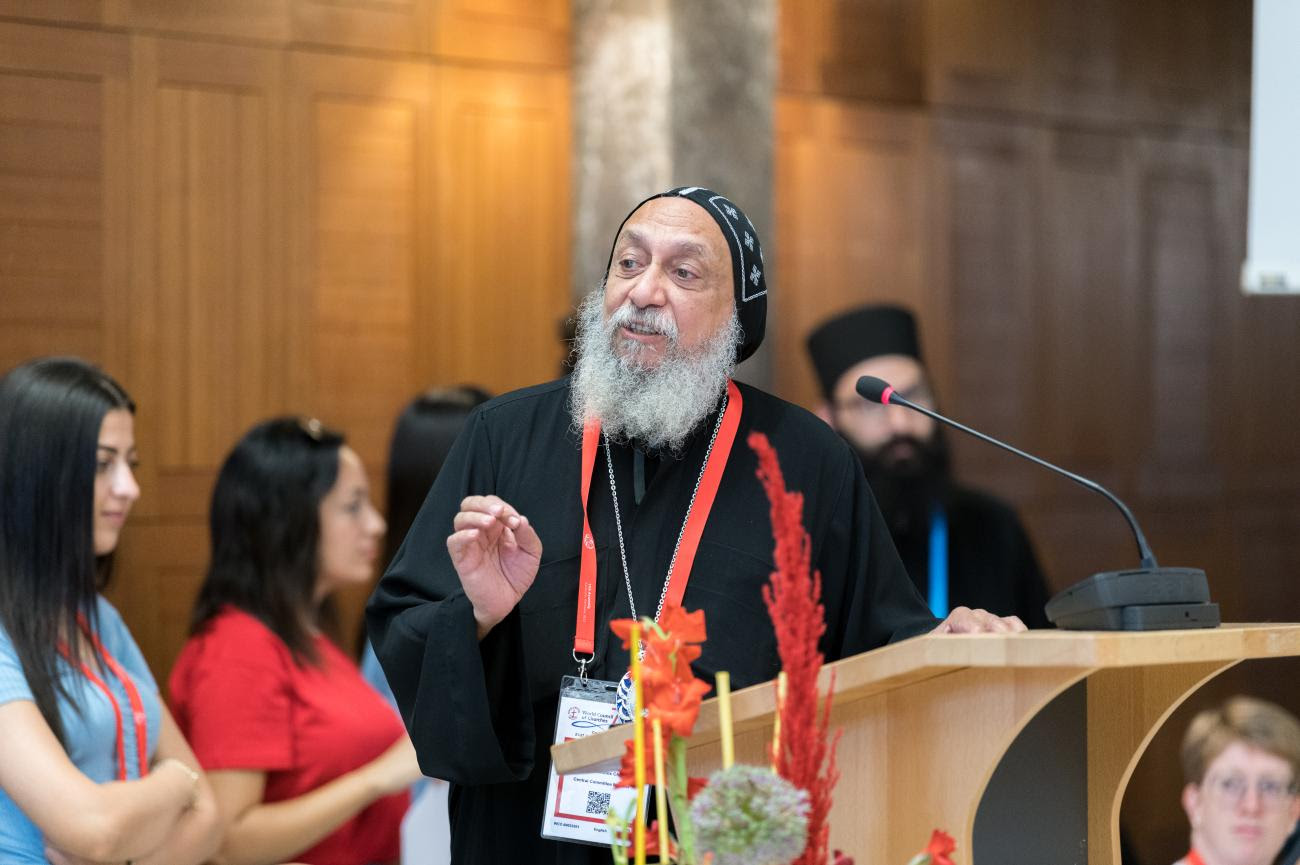
26 June 2023, Geneva, Switzerland: Metropolitan Thomas of the Coptic Orthodox Church shares from the Middle East region as the World Council of Churches central committee gathers in Geneva on 21-27 June 2023, for its first full meeting following the WCC 11th Assembly in Karlsruhe in 2022. Photo: Albin Hillert/WCC
See more
The World Council of Churches on Twitter
The World Council of Churches on Facebook
The World Council of Churches' website
The World Council of Churches on Instagram
The World Council of Churches on YouTube
SoundCloud
The World Council of Churches promotes Christian unity in faith, witness and service for a just and peaceful world. An ecumenical fellowship of churches founded in 1948, today the WCC brings together 352 Protestant, Orthodox, Anglican and other churches representing more than 580 million Christians in over 120 countries, and works cooperatively with the Roman Catholic Church. The WCC general secretary is Rev. Prof. Dr Jerry Pillay from the Uniting Presbyterian Church in Southern Africa. 

Media contact: +41 79 507 6363; www.oikoumene.org/press
Our visiting address is:
World Council of Churches
150 route de Ferney
Geneve 2 1211
Switzerland

Friday, February 18, 2022

WCC NEWS: Rootedness and witness at the heart, as Middle East churches look towards WCC assembly

With the World Council of Churches central committee meeting in February 2022, representatives of churches of the Middle East gathered to reflect on current challenges and ongoing witness as the fellowship journeys towards its next assembly.
East Jerusalem, February 2020.   Photo: Albin Hillert
17 February 2022

The group convened under the leadership of H.E. Metropolitan Dr Vasilios of Constantia – Ammochostos, who reflected on the preciousness of meeting in fellowship at this point in time.

“The Middle East is in many ways a burdened area, as we all live and experience every day. But even so, it is important that our churches can exchange ideas and propose activities to promote peace in our region,” the Metropolitan said.

Bearing witness from various diasporas around the world, including in the USA and Australia, participants noted the need to reflect on the life and witness of churches in the region as a whole, as a number of countries and communities face precarious situations forcing many to leave their homes to take refuge or emigrate.

“What can the World Council of Churches as a global fellowship do to live out solidarity with Christians in the Middle East?” the group asked.

There is a need to look at the whole region and the challenges our brothers and sisters face, urged Dr Theodora Issa of the Syrian Orthodox Patriarchate of Antioch and All the East.

Taking the example of the threats that many Syrian Christians have lived under in the past number of years, Issa also reflected on the dilemma of a local church losing many of its members, while at the same time it is impossible to say that people should not migrate when the safety of their children cannot be ensured.

Yet even amid such deep challenges, the Very Rev. Archimandrite Jack Khalil of the University of Balamand in Lebanon observed a sign of hope in a testimony from the Lebanese perspective, and following a recent visit to Damascus: “Although there are many challenges remaining, I could see a Damascus that was again full of life, restaurants and businesses springing up again, and Christians rebuilding churches that were destroyed. It gives real hope to see people try to recover from war, and fighting against economic problems.”

“Perhaps we can say this is a cry from Middle East Christians: ‘we want to stay home’,” Metropolitan Vassilios reflected.


An assembly theme that looks to the world

As the next meeting of the WCC’s highest governing body draws closer, Metropolitan Vassilios continued to reflect on the assembly theme of “Christ’s love moves the world to reconciliation and unity.”

“In the past, we have mostly spoken about the unity of the church, of Christians around the world,” Vassilios reflected. “Now through this theme, we have the opportunity to embrace the unity of the world, so what does this mean? Is the WCC coming out of introspection and moving outside to see the whole world?” he asked.

The Archimandrite Jack Khalil said, “when we go anywhere, we are always convinced that Christ’s love is the solution, that Christ’s love teaches us.” 

Anne Glynn Mackoul, Greek Orthodox Patriarchate of Antioch and All the East, USA, reflected: “When we gather as an assembly, we inevitably speak not only to each other, but to the world. We need to model what it means to live Christian love. Can we be strong enough, love each other enough, to present a compelling story to the world, can we model a sacrificial love so that people say ‘look at the Christians, how they love each other´?”

“Love, peace, is the foundation of the kingdom of God. We need to not only speak for us, but to speak to the world,” Vassilios concluded.
 

WCC central committee meeting 2022

Learn more about the WCC 11th Assembly

See more
The World Council of Churches on Facebook
The World Council of Churches on Twitter
The World Council of Churches on Instagram
The World Council of Churches on YouTube
World Council of Churches on SoundCloud
The World Council of Churches' website
The World Council of Churches promotes Christian unity in faith, witness and service for a just and peaceful world. An ecumenical fellowship of churches founded in 1948, today the WCC brings together 349 Protestant, Orthodox, Anglican and other churches representing more than 550 million Christians in over 120 countries, and works cooperatively with the Roman Catholic Church. The WCC acting general secretary is Rev. Prof. Dr Ioan Sauca, from the Orthodox Church in Romania.

Media contact: +41 79 507 6363; www.oikoumene.org/press
Our visiting address is:
World Council of Churches
150 route de Ferney
Geneve 2 1211
Switzerland

Monday, June 28, 2021

WCC NEWS: Middle East region reflects on ‘continued holy witness’ and the road towards upcoming WCC assembly

Gathered on 24 June as part of the World Council of Churches (WCC) central committee meeting, representatives from churches and ecumenical organizations in the Middle East took stock of old and new challenges in the region where Christianity itself originated, reflecting on the contributions Middle Eastern Christians can make at the upcoming WCC 11th Assembly. 
Old City, Jerusalem, May 2016. Photo: Albin Hillert/WCC
25 June 2021

Dr Theodora Issa of the Syrian Orthodox Patriarchate of Antioch and All the East reflected on a currently dire situation for many people in the region, and importance of prayer on the road ahead. 

“We are in need of prayers, for the people, and for the church. People in the Middle East are suffering not only from COVID-19, lack of vaccine, the financial situation, many are really struggling to live,” she said. 

Dr Michel Abs, who spoke from his perspective as secretary general of the Middle East Council of Churches, continued to describe the region today as full of societies in transition – amid influences from both East and West – and of cultural and social contradictions. 

“We see today the prediction that people who are poor in the region today, will remain poor for several decades,” he said, noting a plethora of challenges including environmental challenges, unemployment, economic and political struggles. 

Yet he also stressed the many contributions Christians in the region continue to make as part of their witness and service. In Palestine, for example, Christians are still operating schools, universities and hospitals, he said. “What we need now is unity, to work as a system, to be united and to be unifying,” Abs added. 

Bearing witness, in the region and the diasporas

Speaking from the United Kingdom and the Middle East and African diaspora, Coptic Orthodox Bishop Angaelos described how the lived experience of Christians in the region can serve as a basis for witness and also advocacy in the present day. 

“A thousand years ago, there was an attempt to eradicate the Coptic language and culture. It’s beautiful today, to see that a thousand years later, we’ve taken our own experience of persecution and are able to use it now to advocate for the most vulnerable communities, when we see the suffering of others,” he reflected. 

“In some ways, the uprisings in the Middle East, and even COVID-19 — have brought us closer together. We are a fractured body, but it still is the body of Christ, and we still have a responsibility to be one, as much as we can be,” he concluded.

As the group then looked towards the next WCC assembly, linkages between history, tradition, and current realities came to the fore.

Dr Audeh Quawas from Jordan, member of the WCC Central Committee and part of the WCC Assembly Planning Committee brought updates on the plans that are currently taking shape, and stressed the importance of Middle East churches taking an active part in the event.

“We have to come prepared. I am hopeful that many Middle East voices can be heard at the assembly,” Quawas said. 

“We know that we are experiencing some advances in ecumenical relations, and at the same time we have old and new challenges that we need to express in a timely and clear way,” observed the Very Rev. Archimandrite Jack Khalil of the University of Balamand in Lebanon. 

“Yet it is something very beautiful, the churches of the Middle East that uphold the mission of the gospel to the whole world. That has kept the whole tradition, the seed from the gospel, intact, as the churches are called to continue their holy witness, whether it is here in the Middle East, or in the diasporas,” he concluded

WCC central committee meeting 2021

The 11th Assembly of the WCC in Karlsruhe, Germany

See more
The World Council of Churches on Facebook
The World Council of Churches on Twitter
The World Council of Churches on Instagram
The World Council of Churches on YouTube
World Council of Churches on SoundCloud
The World Council of Churches' website
The World Council of Churches promotes Christian unity in faith, witness and service for a just and peaceful world. An ecumenical fellowship of churches founded in 1948, today the WCC brings together 350 Protestant, Orthodox, Anglican and other churches representing more than 550 million Christians in over 120 countries, and works cooperatively with the Roman Catholic Church. The WCC acting general secretary is Rev. Prof. Dr Ioan Sauca, from the Orthodox Church in Romania.

Media contact: +41 79 507 6363; www.oikoumene.org/press
Our visiting address is:
World Council of Churches
150 route de Ferney
Geneve 2 1211
Switzerland

Friday, January 8, 2021

WCC NEWS: From Bethlehem: “We have peace despite our circumstances”

Rev. Dr Munther Isaac from the Evangelical Lutheran Christmas Church in Bethlehem, is academic dean at the Bethlehem Bible College. Below, he reflects on how, during 2020, the celebration of Christmas in Bethlehem, though vastly different than in the past, still brought hope and comfort.
The Evangelical Lutheran Christmas Church in Bethlehem. Photo: Albin Hillert/WCC
07 January 2021

How did you celebrate Christmas in Bethlehem in 2020?

Dr Isaac: Thank God for the gift of technology! In the last few months, we have relied heavily on online services using our social media platform. Christmas was not that much different. We are asking people to put their health and that of their neighbors first. Those wishing still to attend the Christmas services, were asked to wear masks the whole time and stay distant from one another; alternatively, people could pray from their homes while watching our services online.

What does Bethlehem look like, with churches open or closed? Is the Christmas tree lit as always?

Dr Isaac: Bethlehem is not the same this year. Streets are empty. No pilgrims, shops are closed, and the manger square looks different. We did light the Christmas tree, but the celebration took place without the people! It was just a few clergy, and state and city officials.

Most churches went on as planned with Christmas services, but with very limited participation. The same is true about the traditional processions on 24 December welcoming the Patriarchs into Bethlehem—they took place but with very limited participation.

How did you reach out to your congregation during the Christmas season?

Dr Isaac: These are difficult days for the Bethlehem community. It is hard to put into words the economic effects of the pandemic, given that Bethlehem relies heavily on tourism. Churches are trying to help as much as they can, by giving financial and moral support. It is hard to see families struggling to survive. At the same time, it is encouraging to see the response of many of our church members and our community, and of course many partner churches, who gave generously to support our ministry.

At the same time, some of our members were infected by COVID-19, and we try to encourage them on the phone and on social media. 

In my sermons this month, I focused on the idea of God having solidarity with us! During Christmas, we remember how the Word became flesh, and this happened in very difficult situations. Jesus became a man in challenging times; things were never easy for him while he was on earth. He was not born or raised in a position of privilege. This is empowering and a source of comfort.

Do you have a wish or prayer for the fellowship of churches from Bethlehem?

Dr Isaac: That we realize the power in the reality of “Immanuel." We are indeed not alone—it might feel so, with the political reality of isolation; the daily reality of walls and checkpoints; and COVID-19. Yet I hope and pray that we remember, that in the midst of all of this, and despite all of this, we can find comfort and true peace in the baby born in a cave! We have peace despite our circumstances, not because of them.

WCC member churches in the Holy Land

Christmas Carols from Bethlehem

WCC Christmas Message 2020

In 2020 Christmas message, WCC puts forth “fragile hope” and “sound of angels in the air”

See more