Showing posts with label Armenia. Show all posts

Saturday, September 28, 2024

WCC News: WCC moderator to Armenian churches and people: “we constantly pray for you”

Attending the reconsecration of the Mother Cathedral and the Blessing of the Holy Myron, World Council of Churches (WCC) moderator Bishop Dr Heinrich Bedford-Strohm brought greetings on behalf of the fellowship of 352 churches in 120 countries.
During the visit to Armenia on 18-22 September 2023, WCC delegation visited a 13th-century Noravank monastery, located in Amaghu River gorge, near the town of Yeghegnadzor in Armenia. Photo: Peter Prove/WCC
27 September 2024

His Holiness Karekin II, the Patriarch and Catholicos of all Armenians, presided over the reconsecration ceremonies. 

“The reason for my visit is a beautiful one,” said Bedford-Strohm. “What could be a more wonderful way to bring us together as the global community of churches than the reconsecration of one of the oldest churches on this globe!”

He also reflected that the church’s walls hold many stories of blessings in which people have found strength and comfort especially in difficult times.

“Armenia does presently go through difficult times,” he said. “This visit is also an important opportunity to tell you how much we think of you, how we constantly pray for you.”

A WCC delegation led by WCC general secretary Rev. Prof. Dr Jerry Pillay was present when renewed attacks at the Lachin corridor in September 2023.

“Now you are impressively mastering the task of sheltering so many refugees and struggle to find a sustainable solution, which will not result in another war,” said Bedford-Strohm. “Please know that you have friends all over the world who are with you. The WCC certainly is certainly a close one.”

In Armenia, WCC general secretary speaks for justice (WCC news release, 22 September 2023)

See more
The World Council of Churches on Facebook
The World Council of Churches on Twitter
The World Council of Churches on Instagram
The World Council of Churches on YouTube
World Council of Churches on SoundCloud
The World Council of Churches' website
The World Council of Churches promotes Christian unity in faith, witness and service for a just and peaceful world. An ecumenical fellowship of churches founded in 1948, today the WCC brings together 352 Protestant, Orthodox, Anglican and other churches representing more than 580 million Christians in over 120 countries, and works cooperatively with the Roman Catholic Church. The WCC general secretary is Rev. Prof. Dr Jerry Pillay from the Uniting Presbyterian Church in Southern Africa.

Media contact: +41 79 507 6363; www.oikoumene.org/press
Our visiting address is:
World Council of Churches
150 route de Ferney
Geneve 2 1211
Switzerland

Monday, September 16, 2024

News from Jinishian Memorial Program – Sept. 2024

jinishian-logo

Dear Friends,


I want to sincerely thank all of our study tour participants. Seeing Armenia through your eyes helps me appreciate this beautiful country in new ways, even though it’s a place I know so well. Each time we visit the Jinishian Memorial Program’s beneficiaries and see faith in action, I feel even more grateful for our donors and the hard-working staff who make everything possible.


Thanks to the support of the Presbyterian News Service, we are happy to share with you a series of stories and reflections from both our program staff and study tour participants. These stories show the important work of the Jinishian Memorial Program and how it’s making a difference.

I invite you to read these stories and see the impact of what we are doing together. And if you feel inspired, I warmly welcome you to join us on a study tour in 2025 to experience Armenia firsthand and be part of this meaningful journey.


Best Regards,

2024-pns-ElizaMinasyan
e5632f0a-cb37-413d-a5a3-2ebc857e0368

Eliza Minasyan

Executive Director

Jinishian Memorial Program
Presbyterian Church (U.S.A.)


Study tours relay JMP’s impact

2024-pns-JinishianGroupPhoto

JMP offers self-sufficiency and hope to Armenians. The first in a series of stories highlighting JMP’s impact features a Q&A with JMP executive director Eliza Minasyan.

Children’s rehab center makes huge strides in five years

Sevan-Rehab-Center

More than 150 children with mental and physical disabilities are served thanks to JMP funding and oversight. The Rev. Vicki Sauter, guest author, reflects on her past and recent study tour visits to Armenia and the progress that’s been made at the Sevan Rehabilitation Center.

JMP supports wide range of programs

2024-pns-BeekeepersArmenia-375x500

Children’s rehab center, youth leadership, and family businesses are all initiatives that receive assistance from JMP. Guest author Eric Diekhans reflects on his visit to JMP-supported organizations during the most recent study tour to Armenia.

Rich background of Armenian life revealed

GayaneSimonyan

A start-up beekeeping business was made possible through JMP’s loan and business guidance, but it was the “belief in a dream” that made the difference for Gayane Simonyan’s BeeLife Enterprise. Guest author Eric Diekhans profiles his visit to BeeLife and other JMP-supported businesses.

Interested in the 2025 study tour to Armenia?

Sevan

If these stories have inspired you to learn more about Armenia and/or JMP, consider joining the 2025 study tour. For more information, including an itinerary and application, click the box below.

2023 Gratitude Report

Report-Cover

Please read JMP’s 2023 Gratitude Report and share it with others.

Consider a gift to JMP

jmp_logo-1

Your gifts go directly to build up health, faith, farms and businesses by empowering local JMP teams in Armenia, Lebanon, Syria, Istanbul, Jerusalem and Georgia. To make the greatest impact, consider making a monthly gift.


Thank you for standing in unity with Armenian Christian leaders to share God’s love with the most vulnerable and to build a brighter future for all!

Facebook
LinkedIn
Instagram

Wednesday, May 29, 2024

WCC Interview: Bishop Mikael Mogren shares world perspective—and deep local ties—from visit to Armenia

Rt. Rev. Dr Bishop Mikael Mogren, from the Diocese of Västerås in the Church of Sweden (Lutheran), recently returned from a trip to Armenia, where he met with H.H. Catholicos Karekin II, Supreme Patriarch and Catholicos of All Armenians, as well as local church leaders and nongovernmental organizations. He took time to reflect on what has stayed on his mind and in his heart as he returned to Sweden. 
Rt. Rev. Dr Bishop Mikael Mogren from the Church of Sweden meeting with H.H. Catholicos Karekin II, Supreme Patriarch and Catholicos of All Armenians. Photo: courtesy of Mikael Mogren
28 May 2024

“So many different things were touching and deeply moving,” began Mogren. 

But it’s the children who have stayed uppermost in his mind. “The kids, the refugee kids who could have had totally different lives—but the border was blocked,” he said. “In just hours, everything was lost for them.”

And, as he saw the lives of children disrupted, he also saw the desecration of historic Christian landmarks that go back to the origins of Christianity. 

“All of the marks of our history and our church—monasteries, cemeteries, damaged by bulldozers,” he said. “That gives me nightmares, actually.”

He wonders why the world, in many ways, seems to have forgotten this small corner of Armenia, where people are trying mightily not only to survive day-to-day but also to salvage a history that holds some of the deepest roots of Christianity itself.

“Think about losing your history and your family, your own personal roots—and yet being silenced in the world,” said Mogren. “It destroys their world view—and our world view.”

Particularly in western countries, the media has saturated its audiences with images and news of other conflicts in the world—but not what’s transpiring in Armenia. 

“Why is it outside the field of interest?” wondered Mogren, who also observed that, every day, people are caring for their neighbors in Armenia in ways that are nothing short of miraculous.

“I saw fantastic things happening in the parishes, how the congregations are taking care of all the refugees who are coming,” he said. “My interpretation is that it’s part of a very solid state-church system.”

While churches have the responsibly for a lot of society—and many of the refugees—there is also a natural cooperation from local municipalities. Healing is happening. 

“I visited a Sunday School, and it was so impressive how a Sunday School can provide methods for healing,” said Mogren. “Even those these kids had dark minds after a catastrophe, they can reach a creative normalcy.”

Nongovernmental organization such as the Red Cross were also shouldering a major portion of the response to refugees, the desecration of cultural heritage, and political and war prisoners taken by Azerbaijan. 

Photo: courtesy of Mikael Mogren

World outlook, local ties

Mogren took with him to Armenia strong ties from Sweden—ties he’s had since he was a child. 

“When I was a young man, I realized our churches are very similar,” he said. “We have a similar tradition. Our churches have a history of lay people in leading positions and in governing boards. Lay people play a strong role even in the traditional liturgy of our churches.” 

He added: “We are national churches contributing to our countries with cohesion and worship.” 

Armenians also have a mixture of different cultures in their heritage. “I have that in my heart, too,” said Mogren. “And we have a long history of collaboration and influences.”

In 1901, the Missionary Society of Swedish women sent Alma Johansson to Mush (Western Armenia), where she stayed until December 1915. There she worked for the German Hilfsbund-Orphanage for Armenian children. At the outbreak of World War I, the atrocities against the empire's Christian minorities escalated and she became an eyewitness to these crimes against humanity. She wrote about her experiences in the book "A People in Exile: One Year in the Life of the Armenians.”

“She saw with her eyes the genocide—and she protested,” said Mogren. “She delivered worldwide news.”

During his trip to Armenia, Mogren left a bouquet of flowers at a monument to Johansson. 

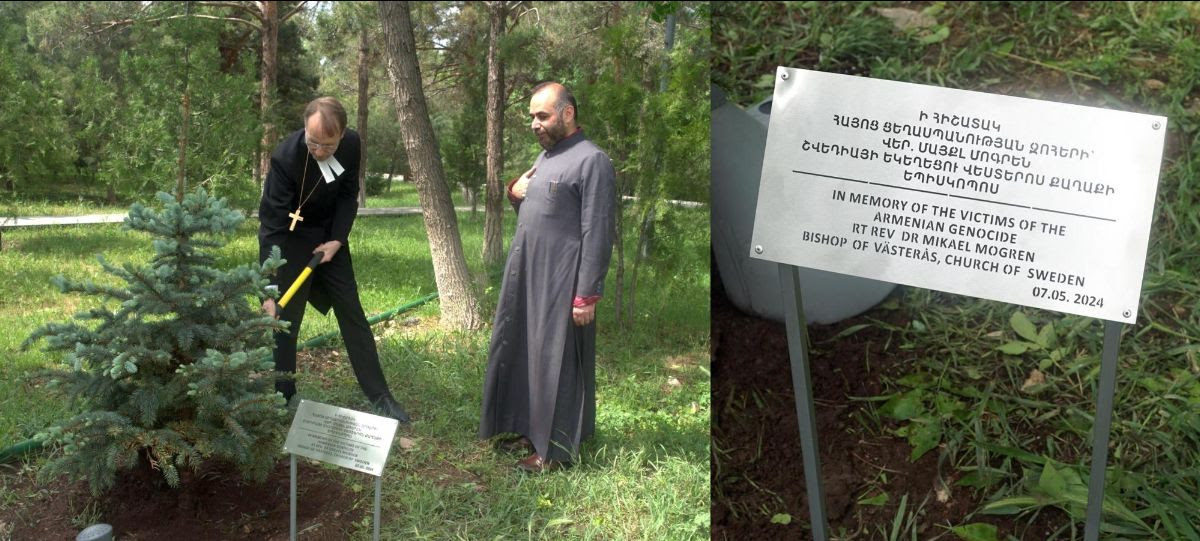
“And I planted a tree,” added Mogren, who regarded the act of planting as both an honor and a duty. “They have a little forest of trees that represents the victims of genocide.” 

Spreading the word

Now back in Sweden, Mogren is still spreading the word about the plight of refugees, the hope churches provide, and the precious history of Christianity in Armenia. 

“I did my journey with a journalist from Sweden,” explained Mogren. “He’s a man whose stories were aligned with my heart, so called him even though we had never met, to say ‘will you join?’ And he joined me.”

Now, the journalist is producing a lot of media, Mogren said with appreciation. “At the same time, I have activated my contacts in the Swedish government, and I’ve spontaneously, from my own side, been making reports,” he said. “I have a responsibility to spread the word.”

Pray for open eyes

Mogren asked for the World Council of Churches global fellowship to pray for open eyes among not only decision-makers but among everyone in the world who wants a wider perspective of Armenia.

“They are our root system for the whole Christian culture,” he said. “Without these roots—without the cities and villages and monuments from the early Christian days—our Christianity would be different.”

He urged people to care about the state of original Christianity. “We are coming from rich and dominating countries in the west,” he said. “Sometimes we in the west have the blindness of the privileged.”

As Mogren tries to enhance the world view of others, his heart stays grounded in his local setting. 

He reflected on the legacy of Nathan Söderblom, the first clergyman to receive the Nobel Peace Prize. Söderblom was the Church of Sweden Archbishop of Uppsala from 1914 to 1931.

“He gives me a lot of inspiration because his heart was in the local yet he could combine that with a wide perspective,” explained Mogren. “His ecumenism is very inclusive.” 

As Mogren meets immigrants who come to Sweden from the east, he regards them with gratitude. 

“These groups are an intense part of history in Sweden,” he said. “They are my friends and I share with them, and I get to understand their situations. My native place here in Sweden has a root system because of them—700 or 800 years has been filled out by immigrants coming from very old churches.”

Church of Sweden

Armenian Apostolic Church (Mother See of Holy Etchmiadzin)

See more
The World Council of Churches on Twitter
The World Council of Churches on Facebook
The World Council of Churches' website
The World Council of Churches on Instagram
The World Council of Churches on YouTube
SoundCloud
The World Council of Churches promotes Christian unity in faith, witness and service for a just and peaceful world. An ecumenical fellowship of churches founded in 1948, today the WCC brings together 352 Protestant, Orthodox, Anglican and other churches representing more than 580 million Christians in over 120 countries, and works cooperatively with the Roman Catholic Church. The WCC general secretary is Rev. Prof. Dr Jerry Pillay from the Uniting Presbyterian Church in Southern Africa. 

Media contact: +41 79 507 6363; www.oikoumene.org/press
Our visiting address is:
World Council of Churches
150 route de Ferney
Geneve 2 1211
Switzerland